deportation of Armenian intellectuals on 24 April 1915 is a saint of the Catholic Church.
Yerevantsi
License: CC BY-SA 4.0
deportation of Armenian intellectuals on 24 April 1915
Saint- Church
- Catholic
Biography
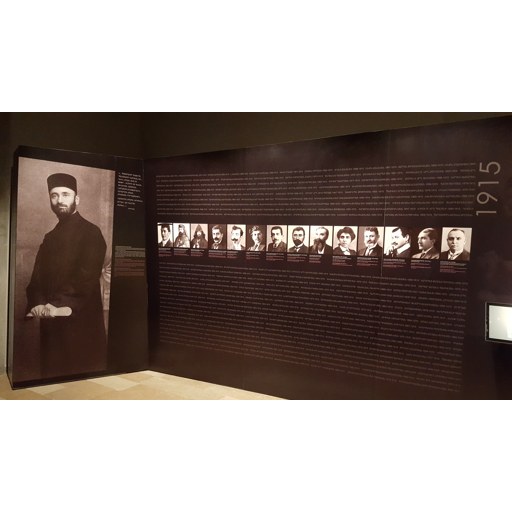
The deportation of Armenian intellectuals on 24 April 1915, often called Red Sunday, is conventionally treated as the opening act of the Armenian Genocide in the Ottoman Empire. On the night of 24–25 April 1915, Ottoman police in Constantinople arrested a large group of Armenian community leaders—politicians, clergy, physicians, journalists, teachers, lawyers, and writers—on orders associated with Interior Minister Talaat Pasha and the Committee of Union and Progress government. Estimates of those seized in the capital that night commonly fall in the range of about 235 to 270 persons; further arrests followed in Constantinople and in provincial centers in subsequent days. The round-up targeted the Armenian elite of the imperial capital rather than a random sample of the population.
Detainees were held at the central police station and then moved via Haydarpaşa railway station into the interior of Anatolia. Many were sent to holding sites at Ayaş and Çankırı near Ankara. In the months that followed, the majority were killed by execution, by irregulars, or by the conditions of further deportation. A smaller number survived. Among the best-known victims who did not survive were the poet Daniel Varoujan, the poet Siamanto (Atom Yarjanian), and the writer and Ottoman parliamentarian Krikor Zohrab. The composer Komitas was among those later released; he suffered lasting psychological collapse. Lists of names survive in contemporary and later sources, but they are incomplete, and killings continued after the first transfers.
The arrests occurred during the First World War, after the Ottoman Empire had joined the Central Powers and after serious Ottoman military setbacks, especially in the Caucasus. Officials presented the operation as a wartime security measure against alleged Armenian revolutionary activity. Historians of the genocide have interpreted the destruction of the intellectual and political leadership as a deliberate step meant to leave the wider Armenian population without spokesmen or organizers at the start of a broader campaign of deportation and massacre across eastern Anatolia in 1915 and after. Earlier mass violence, including the Hamidian massacres of the 1890s and the Adana massacre of 1909, forms part of the longer background of Ottoman-Armenian relations in the late nineteenth and early twentieth centuries.
24 April is observed by Armenians as Genocide Remembrance Day. The episode is documented in Ottoman orders, in survivor and diplomat memoirs, and in postwar proceedings against some Unionist officials. Scholarly consensus outside official Turkish state narratives holds that the April 1915 arrests inaugurated a centrally directed genocide in which a very large share of the Ottoman Armenian population died through massacre, death marches, starvation, and disease. Exact totals for the intellectuals themselves remain estimates because documentation is fragmentary and because murder continued after the initial deportations from Constantinople.