Desiderius of Vienne is a saint of the Catholic Church (d. 607). Desiderius of Vienne's feast day is celebrated on 23 May.
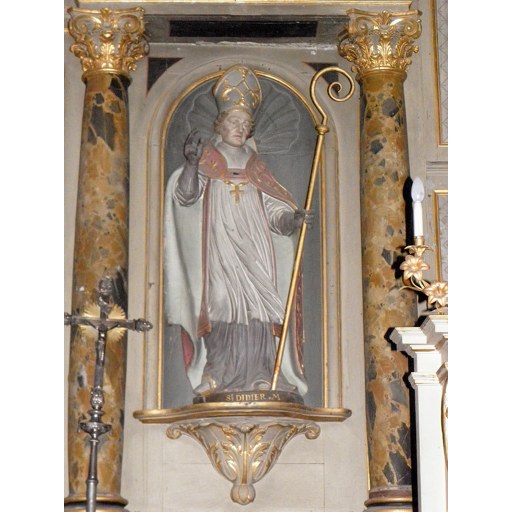
GO69
License: CC BY-SA 4.0
Desiderius of Vienne
Saint- Life Span
- d. 607
- Feast Day
- 23 May
- Gender
- male
- Church
- Catholic
Places
Relics & Where to Venerate
Location unknown
The bodily remains of Desiderius of Vienne are a first-class relic. Venerated at Saint Peter's church.
Roles & Family
Biography
Desiderius of Vienne, known in French as Didier de Vienne, was a late sixth- and early seventh-century metropolitan bishop of Vienne in the Rhône valley of Gaul and is venerated as a martyr in the Catholic Church. He is described in the standard tradition as a native of Autun in Burgundy, from a Gallo-Roman family of standing. He received an education that included both sacred learning and classical Latin letters. He served as archdeacon of Autun before being chosen bishop of Vienne, an ancient metropolitan see. He was already in office by the mid-590s, when Pope Gregory the Great wrote to him as bishop. Vienne lay in the Burgundian territories of the Frankish kingdoms and claimed an early Christian past as a leading church of Gaul.
As bishop he was known for pastoral activity and for a reputation as a man of letters who taught grammar and literature. In a letter of 595 Gregory the Great reproved him for occupying himself with the liberal arts and pagan authors, arguing that a bishop’s mouth should not be employed in the praise of Jove, while otherwise treating him as a respected colleague among the bishops of Gaul. Desiderius also came into open conflict with the Merovingian court of Burgundy. He rebuked King Theuderic II for living with concubines rather than contracting a lawful marriage and opposed the morals and influence of the king’s grandmother, Queen Brunhilda. Near-contemporary writers present this moral confrontation as the source of the hostility that led to his fall.
In 603 a council met at Chalon-sur-Saône under strong court pressure. Desiderius was accused of grave offences, including sexual charges that later ecclesiastical tradition treated as calumnies, and was deposed and sent into exile. After a period of banishment he was restored to Vienne but did not cease his denunciations of the court. Brunhilda and Theuderic then moved to destroy him. In 607 he was seized and killed at a place called Prisciniacum, identified with the later village of Saint-Didier-sur-Chalaronne in the Dombes, in what is now the department of Ain, north of Lyon. Hagiographical accounts say he was stoned, beaten, or dragged to death by men acting for the queen. The settlement at the site of his death took his name, and a church was associated with his tomb there.
His fame spread quickly beyond Francia. An early Life was written by the Visigothic king Sisebut of Toledo (died 621). The Fredegar chronicle and later vitae also narrate his struggle with Brunhilda, mixing political polemic and miracle stories with a core of events supported by Gregory’s letters and by the fact of the deposition at Chalon. Desiderius was honoured as a martyr; his feast is kept on 23 May, and the Roman Martyrology commemorates him as bishop and martyr in connection with Vienne. Bishop Ado of Vienne in the ninth century helped fix his place in martyrological tradition. He remains one of the better-attested episcopal victims of Merovingian court politics, a bishop whose classical education, papal correspondence, deposition, and violent death illustrate the tensions of the Church in Frankish Gaul around the year 600.