Didacus of Alcalá is a saint of the Catholic Church (d. 1463). Didacus of Alcalá's feast day is celebrated on 13 November. Didacus of Alcalá is the patron saint of San Diego, California;Roman Catholic Diocese of San Diego;Franciscan lay brothers.
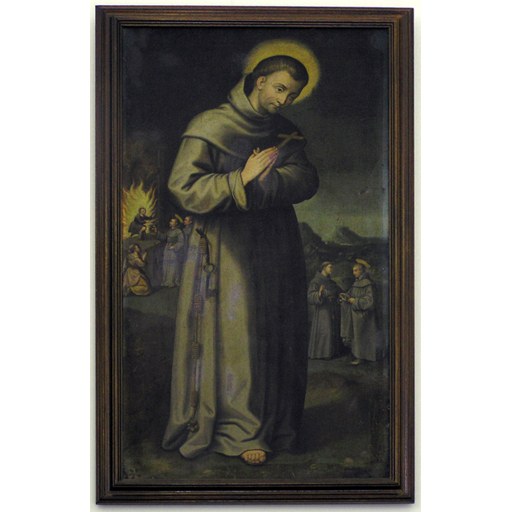
Spanish anonymous (Madrid school)
License: Public domain
Didacus of Alcalá
Saint- Life Span
- d. 1463
- Feast Day
- 13 November
- Gender
- male
- Church
- Catholic
Places


Relics & Where to Venerate
Location unknown
The bodily remains of Didacus of Alcalá are a first-class relic. Venerated at Cathedral of los Santos Niños Justo y Pastor de Alcalá de Henares.
Roles & Family
Religious Information
Patronage
San Diego, California;Roman Catholic Diocese of San Diego;Franciscan lay brothers
Canonization
Biography
Didacus of Alcalá, known in Spanish as Diego de Alcalá or Diego de San Nicolás, was a Franciscan lay brother of the Observant reform. He was born about the beginning of the fifteenth century in the modest Andalusian town of San Nicolás del Puerto, in the Sierra Morena within the Kingdom of Seville of the Crown of Castile. Of poor family, he was drawn early to solitude and asceticism and for a time lived as a hermit. He later sought admission to the Order of Friars Minor and was received as a lay brother, never ordained to the priesthood. In community, especially at the convent of Arruzafa near Córdoba, he undertook the humblest offices, including cooking and the care of the garden, while leading a life of prayer, fasting, and charity toward the poor.
In the 1440s Didacus was sent among the first Franciscan missionaries to the Canary Islands, then recently brought under Castilian authority. He served on Fuerteventura, where, although only a lay brother, he was appointed guardian of the friary, a mark of the confidence placed in his judgment and holiness. He labored among both the indigenous Guanche population and the European settlers, and contemporary accounts associate his stay with works of mercy and reported wonders. After some years he was recalled to the Spanish mainland.
In 1450 he traveled to Rome with other friars of his order for the Jubilee Year and for the canonization of Bernardine of Siena. During an epidemic that struck the large gathering of Franciscans, Didacus was given charge of the sick at the Ara Coeli convent; numerous recoveries were attributed to his prayers and nursing. He subsequently returned to Castile and spent his final years at the Observant convent of Santa María de Jesús in Alcalá de Henares. There he continued a hidden life of work and contemplation until his death on 12 November 1463. He was buried in the convent church; his body was later described as remaining incorrupt.
Popular devotion to Didacus developed quickly after his death. A widely reported miracle in 1562, in which the gravely injured Infante Carlos, son of Philip II, was said to have recovered after contact with Didacus’s relics, gave strong impetus to the cause. Pope Sixtus V canonized him on 2 July 1588. His cult spread throughout the Spanish monarchy. In 1769 the Franciscan missionary Junípero Serra established a mission in Alta California under the name San Diego de Alcalá; the city and the later Roman Catholic Diocese of San Diego take their name from this dedication. Didacus is invoked as patron of Franciscan lay brothers and of San Diego. His liturgical memorial is kept on 13 November in the General Roman Calendar.