Didymus the Blind is a saint of the Catholic Church (313 - 398).
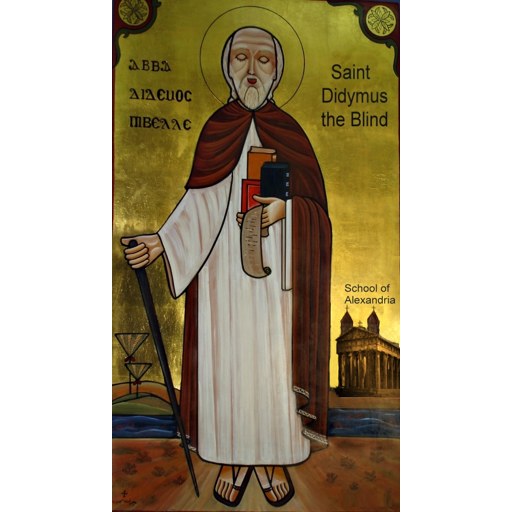
Lizarazo999
License: Public domain
Didymus the Blind
Saint- Life Span
- 313 - 398 (age 85)
- Gender
- male
- Church
- Catholic
Places
Roles & Family
Biography
Didymus the Blind, also called Didymus of Alexandria, was a Christian theologian and biblical exegete of the fourth century who lived and taught in Alexandria in Roman Egypt. Ancient ecclesiastical writers report that he lost his sight to illness when he was about four years old. Unable to read in the ordinary way, he obtained a wide education by hearing texts read aloud and by training an unusually strong memory. He acquired grammar, rhetoric, philosophy, mathematics, and music, and he became especially famous for his command of Scripture. Tradition holds that Athanasius of Alexandria placed him in charge of the Catechetical School of Alexandria, which he led for many years while remaining a layman rather than an ordained bishop or priest.
Despite blindness and lay status, Didymus was visited and praised by leading Christian scholars of his generation. Jerome came to him, spoke of him as a teacher, and translated his treatise on the Holy Spirit into Latin. Rufinus of Aquileia studied under him for several years, and Palladius of Galatia later described the aged Didymus in the Lausiac History, stressing both his learning and his austere, unmarried ascetic life. Didymus defended Nicene orthodoxy against Arianism and argued for the full divinity of the Son and of the Holy Spirit. His work On the Holy Spirit circulated widely in Jerome's Latin version and contributed to fourth-century Trinitarian theology. A treatise On the Trinity has also been associated with him, though modern scholars debate the attribution of some works that survive under his name.
He was a prolific commentator on the Bible, writing at length on Genesis, Job, the Psalms, Ecclesiastes, Zechariah, and other books, generally in the allegorical and spiritual manner of the Alexandrian school and of Origen. Like Origen, he held views on the pre-existence of souls and on a final restoration of all things that later generations judged unorthodox. Contemporary sources present him as a celibate ascetic devoted to study and teaching, with no record of a wife or children. He died in Alexandria near the close of the fourth century; the date commonly given is 398, consistent with reports that he lived about eighty-five years and with Jerome's notice of him as still alive in the early 390s.
Didymus's later reputation was damaged when the Second Council of Constantinople in 553 condemned Origenist teachings and named him among the associated authors, after which much of his corpus ceased to be copied and was lost. He was not generally retained on later Catholic or Eastern Orthodox calendars of saints, and he received no formal canonization in the medieval Western sense. A major recovery of his writings took place in 1941, when papyrus codices of the sixth or seventh century were discovered at Tura, south of Cairo, preserving substantial portions of his commentaries. Those manuscripts have allowed modern historians to reconstruct his exegesis more fully and to place him more accurately within fourth-century Alexandrian theology, as a Nicene teacher of great erudition whose Origenist cosmology led to posthumous condemnation.