Diego Luis de San Vitores is a blessed of the Catholic Church (1627 - 1672). Diego Luis de San Vitores's feast day is celebrated on 6 October.
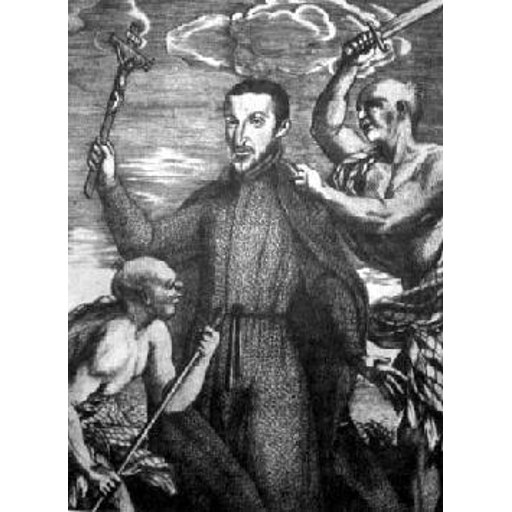
The original uploader was Onionhound at English Wikipedia.
License: Public domain
Diego Luis de San Vitores
Blessed- Life Span
- 1627 - 1672 (age 45)
- Feast Day
- 6 October
- Gender
- male
- Church
- Catholic
Places
Roles & Family
Religious Information
Canonization
Biography
Diego Luis de San Vitores was born on 12 November 1627 in Burgos, Spain, into a noble Castilian family. His father, Don Jerónimo de San Vitores, served at the royal court, and his mother was Doña María Alonso Maluenda. Raised in a devout household, he received his early education from the Jesuits and showed a strong religious inclination from childhood. In 1640, against the wishes of his father, who hoped he would follow a career in royal service, he entered the novitiate of the Society of Jesus. He completed Jesuit formation in Spain, studying philosophy and theology, and was ordained to the priesthood. For a number of years he taught grammar, rhetoric, and theology and became known as an effective preacher. He repeatedly asked his superiors to send him to the foreign missions.
In 1660 he was assigned to the Province of the Philippines. He crossed the Atlantic to New Spain and, after a period in Mexico, continued across the Pacific, arriving in Manila in 1662. In the Philippines he taught at the Colegio de San José and engaged in pastoral work. He became convinced that the inhabitants of the islands north of the Philippines, then called the Islas de los Ladrones, should receive a stable mission. With the patronage of Mariana of Austria, queen regent of Spain during the minority of Charles II, he obtained royal and Jesuit approval. In 1668 he left the Philippines with a small band of Jesuit priests and brothers and several Filipino lay catechists, among whom was Pedro Calungsod. They reached Guam in June 1668. San Vitores gave the archipelago the name Islas Marianas in honor of the queen regent.
Upon landing, San Vitores sought the protection of Kepuha, the principal chief of the Hagåtña area. Kepuha accepted baptism and granted land on which the missionaries built a church and residence dedicated to the Dulce Nombre de María. San Vitores set about learning the Chamorro language, drafted a grammar and a catechism, and traveled from village to village on Guam and to neighboring islands. He baptized large numbers of adults and infants and attempted to replace traditional religious practices, including the keeping of ancestral skulls, with Catholic sacramental life. Spanish soldiers who accompanied the mission often treated the islanders harshly, and outbreaks of disease were blamed on the newcomers. Some chiefs who had initially welcomed the Jesuits later rejected them. San Vitores continued to insist on baptizing children even when parents objected, a policy that increased hostility.
On 2 April 1672 San Vitores and Pedro Calungsod went to the coastal village of Tumon to baptize a newborn girl. Her father, Matå'pang, had been baptized earlier but had abandoned the Christian faith and forbade the baptism. When the missionaries persisted, Matå'pang and a companion named Hirao attacked them with spears and a machete, killing Calungsod first and then San Vitores. The bodies were placed in a canoe, weighted, and thrown into the sea off Tumon. News of the killing led to Spanish military reprisals and to a prolonged period of conflict, often called the Spanish-Chamorro Wars, which lasted into the late seventeenth century and, together with disease and forced relocation, greatly reduced the Chamorro population. San Vitores was beatified by Pope John Paul II on 6 October 1985. He is honored as the Apostle of the Marianas; churches, educational institutions, and a shrine near the site of his death on Guam commemorate his work. He remains a blessed of the Catholic Church and has not been canonized. His companion Pedro Calungsod was canonized in 2012.