Dionysius Exiguus is a saint of the Catholic Church. Dionysius Exiguus's feast day is celebrated on 1 September.
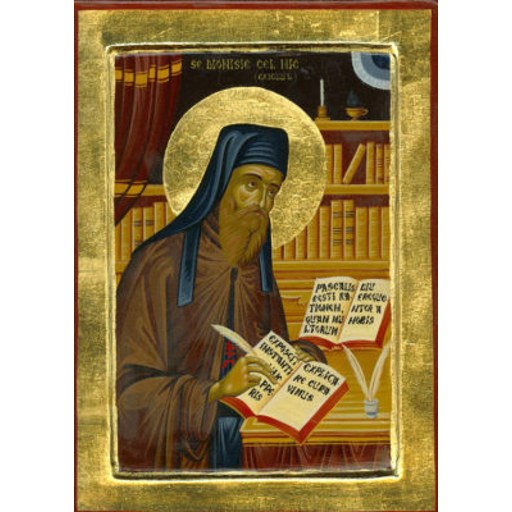
Unknown authorUnknown author
License: Public domain
Dionysius Exiguus
Saint- Feast Day
- 1 September
- Gender
- male
- Church
- Catholic
Places
Roles & Family
Biography
Dionysius Exiguus was a monk, translator, and computist of the late fifth and early sixth centuries, later remembered above all as the scholar who introduced the Anno Domini system of numbering years from the Incarnation of Christ. He was a native of Scythia Minor, the Roman province on the western shore of the Black Sea that corresponds to the modern Dobruja of Romania and Bulgaria. He identified himself as a Scythian and used the byname Exiguus, meaning the Humble or the Little, as a conventional mark of monastic humility rather than as a description of his stature or rank. No surviving contemporary document gives a precise year of birth or of death; reference works therefore locate his life only approximately in the period from the later fifth century to the middle of the sixth. He was a monk, not a bishop, and he never held the office of pope or patriarch.
By the opening of the sixth century he was living in Rome, where he remained for the rest of his life. He was fluent in both Greek and Latin when competence in Greek had become uncommon among Western clergy, and he employed that bilingual skill as a translator and as a compiler of church law. His collection of canons, known as the Collectio Dionysiana, offered Latin versions of the canons of the Eastern councils together with selected papal decretals. The work was widely copied and, in a later recension called the Dionysio-Hadriana, became a standard source of canon law in the Frankish church. Cassiodorus, writing in the mid-sixth century, praised Dionysius as a man of exceptional learning and holiness who taught in Rome, and he indicated that Dionysius did not transfer to the monastic school Cassiodorus was establishing at Vivarium in southern Italy.
Dionysius’s Easter tables were prepared at the request of Roman ecclesiastics who needed a continuation of the Alexandrian computus associated with Cyril of Alexandria. Those earlier tables counted years from the accession of Diocletian, the so-called Era of the Martyrs. Dionysius declined to reckon time from a persecutor of Christians and instead numbered years from the Incarnation. He identified the year of the Incarnation with 753 ab urbe condita and produced a ninety-five-year cycle of Easter dates. Subsequent historical research has concluded that his date for the Nativity was several years too late, yet the Anno Domini era he employed was adopted by later Latin computists, most influentially by Bede in the eighth century, and in time became the ordinary civil and ecclesiastical chronology of Western Europe.
He was associated with the Scythian monks from his native province who, in the 510s, advocated the Theopaschite formula that one of the Trinity suffered in the flesh, a phrase intended to protect the unity of Christ’s person in the tradition of Cyril of Alexandria. Dionysius also translated a range of Greek theological and hagiographical writings into Latin, helping to make Eastern monastic and patristic literature available in the West. He lived as a monk in Rome and is not recorded as having married or fathered children. After his death he was remembered principally as a canon lawyer and as the originator of the Christian era in dating. In certain Eastern Orthodox traditions, particularly within the Romanian Orthodox Church, he is venerated as a saint and commemorated on 1 September; he has no established cult or list of patronages in the Roman Catholic liturgical books.