Dionysius is a saint of the Catholic Church (d. 268). Dionysius's feast day is celebrated on 26 December.
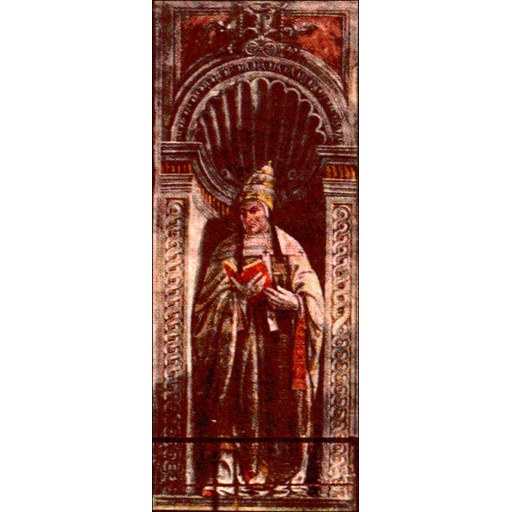
Unknown authorUnknown author
License: Public domain
Dionysius
Saint- Life Span
- d. 268
- Feast Day
- 26 December
- Gender
- male
- Church
- Catholic
Places
Roles & Family
Biography
Pope Dionysius was Bishop of Rome in the mid-third century, traditionally from 22 July 259 until his death on 26 December 268. Almost nothing can be established with certainty about his birth, family, or early career. Later Roman tradition, including the Liber Pontificalis, describes him as a Greek and as a monk who was already a priest of the Roman church when chosen to succeed Sixtus II. Sixtus had been put to death in August 258 during the persecution ordered by the emperor Valerian, and the Roman see then remained vacant for nearly a year while the Christian community was under severe pressure. Dionysius's election therefore took place as the church in the capital began to emerge from that crisis.
The political situation changed soon after he took office. Valerian was captured by the Persians in 260, and his son Gallienus adopted a more tolerant policy toward Christians, restoring places of worship and cemeteries that had been confiscated. Ancient sources present Dionysius as the organizer of the Roman church in this period of recovery. The Liber Pontificalis credits him with assigning churches to priests and with bringing order to the city's Christian communities and burial grounds, though that text was compiled centuries later and must be used with caution. What is clearer from earlier witnesses is that he corresponded widely and acted as a point of unity for churches beyond Italy.
The best-documented episode of his pontificate is the doctrinal exchange with Dionysius of Alexandria. Complaints reached Rome that the Alexandrian bishop, in opposing Sabellianism, had so distinguished the Father and the Son as to threaten the unity of God, and that he had been reluctant to use the language of coeternity or of one substance. A synod at Rome considered the accusations. Pope Dionysius wrote to his namesake asking for an explanation and setting out the Roman church's insistence that the Son is not a creature, is coeternal with the Father, and is of one substance with Him, while also rejecting both Sabellian collapse of the persons and any multiplication of gods. Dionysius of Alexandria replied at length, defending his orthodoxy. Fragments of this correspondence, preserved especially by Athanasius in the fourth century, are among the most important surviving witnesses to third-century Trinitarian debate and to the Roman bishop's role in it.
Dionysius also appears in the memory of the church of Cappadocia. Basil of Caesarea, writing in the 370s, recalled that Dionysius had sent letters of consolation and money to ransom Christians taken captive in Gothic raids on Pontus and Cappadocia, and Basil treated that generosity as a standing bond between Rome and Caesarea. Dionysius died in Rome on 26 December 268 and was buried in the cemetery of Callistus on the Appian Way, in the area later known as the papal crypt. He has been venerated as a saint in the Roman church; his feast is kept on 26 December. Beyond these points the historical record is thin, as it is for most third-century bishops of Rome, and later medieval elaborations cannot be verified.