Dominic of Sora is a saint of the Catholic Church (951 - 1031). Dominic of Sora's feast day is celebrated on 22 January. Dominic of Sora is the patron saint of Sora;Cocullo;Villalago;against snake bites;against rabies;against toothache;against fever;against wolves.
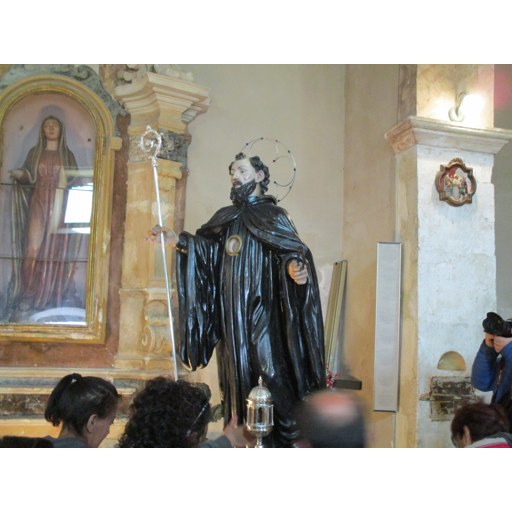
Marica Massaro
License: CC BY-SA 4.0
Dominic of Sora
Saint- Life Span
- 951 - 1031 (age 80)
- Feast Day
- 22 January
- Gender
- male
- Church
- Catholic
Places
Roles & Family
Religious Information
Patronage
Sora;Cocullo;Villalago;against snake bites;against rabies;against toothache;against fever;against wolves
Biography
Dominic of Sora, known in Italian as Domenico di Sora and sometimes called Dominic of Foligno, was a Benedictine monk, hermit, and abbot of the late tenth and early eleventh centuries. He was born at Foligno in Umbria, in central Italy, in the mid-tenth century; later tradition gives the year 951. Almost nothing reliable is recorded of his family or childhood. He entered religious life, was ordained a priest, and then withdrew as a hermit. His eremitical years are associated with Monte Piaia near Scandriglia in the Sabine hills, where disciples gathered around him and he began the work of founding monastic communities that occupied the rest of his life.
In a period of political fragmentation in central Italy, Dominic belonged to the current of Benedictine renewal that sought to restore regular observance of the Rule of Saint Benedict. He founded or restored a series of houses in Lazio and the Abruzzi. Communities linked to him include a monastery at Scandriglia, San Salvatore at Palombara Sabina, San Bartolomeo at Trisulti in the mountains near Collepardo, and foundations in the district of Sora, as well as sites at Pedemonte and elsewhere in the Comino valley and the upper Liri. He combined the life of a wandering preacher and wonder-worker with that of an abbot, moving among his foundations. Near-contemporary memory, later shaped by hagiography, presents him as a severe ascetic who also exercised pastoral care among rural populations of the Apennines.
Dominic spent his last years in the area of Sora, where he established a monastery that afterward bore his name. He died there on 22 January 1031 and was buried at that house; the tomb became a centre of local pilgrimage. Tradition credits him with healings and with protection from dangerous animals. A lasting strand of his cult concerns snakes: he is said to have blessed people against venomous bites, and in later centuries live snakes were associated with his feast. The Abruzzese town of Cocullo developed the Festa dei Serpari, in which a statue of the saint is carried in procession draped with live snakes, a custom often read as a Christian overlay on older rural practice but firmly attached to his patronage.
Veneration spread through the diocese of Sora, the Abruzzi, and neighbouring parts of Lazio and Molise. He is honoured as patron of Sora, Cocullo, and Villalago, and is invoked against snakebite, rabies, toothache, fever, and wolves. His principal feast is 22 January, the date of his death; some localities also keep May observances connected with relics or with the snake festival. He was never the subject of a formal papal canonization of the later medieval or modern type. His cult grew from monastic and popular devotion and was received as that of a saint of immemorial veneration. Relics are kept at Sora and at Cocullo, and churches dedicated to San Domenico di Sora remain in several towns of central Italy.