Domnina of Syria is a saint of the Catholic Church.
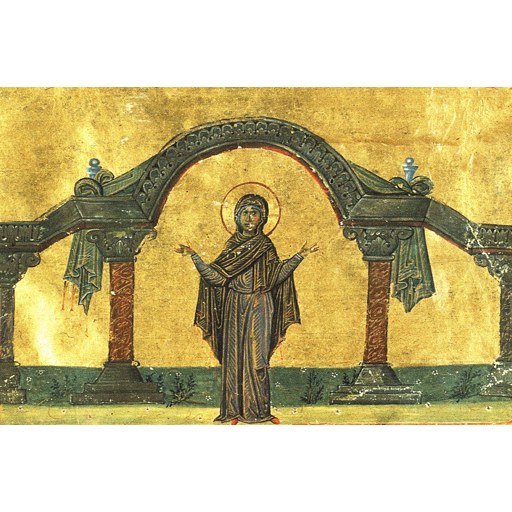
Authors of Menologion of Basil II (circa 985 AC, Constantinople), Byzantine manuscript illuminators[1]: Pantoleon with Georgios, Michael the Younger, Michael of Blachernae, Symeon, Symeon of Blachernae, Menas, and Nestor (Online on Vatican site)
License: Public domain
Domnina of Syria
Saint- Gender
- female
- Church
- Catholic
Places
Roles & Family
Biography
Saint Domnina of Syria was a Christian ascetic of the fifth century whose life is known almost entirely from one contemporary witness. Theodoret, bishop of Cyrrhus (died around the late 450s), devoted a short chapter of his Historia Religiosa, written about 440, to her while she was still living. Theodoret knew the monks and nuns of his diocese in northern Syria personally and wrote to show that prophetic and apostolic holiness continued in the Syrian countryside of his own day. He describes Domnina as a woman of respectable family who, while still young, chose the enclosed life. She built a small hut in her mother’s garden in the territory of Cyrrhus, in the Roman province of Syria Euphratensis, and remained there as a recluse.
Her asceticism followed the severe pattern typical of early Syrian monasticism. She wore a single coarse hair garment that covered her entire body and restricted her food to lentils soaked in water, taken only at long intervals. Prolonged fasting had weakened her frame and reduced her voice to a faint sound. Day and night she occupied herself with prayer, the recitation of psalms, and tears of compunction, which Theodoret treated as the mark of genuine repentance. Although she lived as a solitary, she did not refuse all visitors. Women from the surrounding district came to her cell for spiritual counsel or healing. She spoke little, kept her face veiled so that men should not see her, made the sign of the cross over the sick, and many were said to have recovered.
Domnina is regularly associated with the circle of Saint Maron (Maro), the well-known hermit who occupied a mountain in the same region of Cyrrhus and around whom both monks and nuns gathered. Later tradition therefore often calls her a disciple of Maron. No other ancient author independently confirms the details of her biography; later notices simply repeat or slightly expand Theodoret’s portrait. She remained a consecrated virgin, never married, and had no children.
The exact years of her birth and death are not recorded. She was certainly alive in the 430s and 440s, when Theodoret observed her and composed his account, and she is presumed to have died in the mid-fifth century in the same part of Syria. Subsequent Eastern Christian calendars have numbered her among the saints, though the date of liturgical commemoration is not uniform and she was never the subject of a later formal process of canonization. The historical record, limited as it is, rests on the testimony of a bishop who had seen her with his own eyes and who placed her among the notable women ascetics of fifth-century Syria.