Donatian is a saint of the Catholic Church. Donatian's feast day is celebrated on 14 October. Donatian is the patron saint of Bruges.
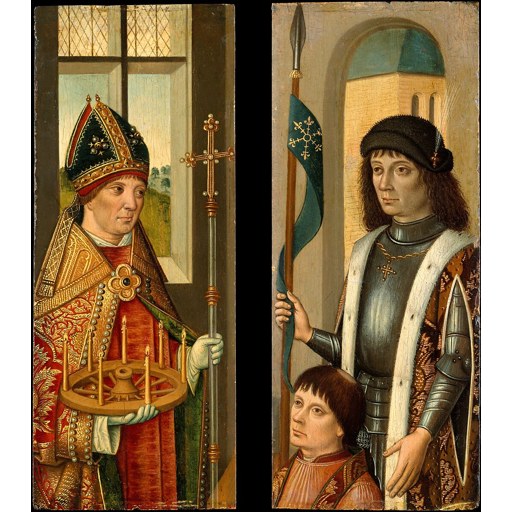
https://www.metmuseum.org/art/collection/search/437199
License: unknown
Donatian
Saint- Feast Day
- 14 October
- Gender
- male
- Church
- Catholic
Places
Roles & Family
Patronage
Bruges
Biography
Saint Donatian, also known as Donatianus or Donatien, was a bishop of Reims in late Roman Gaul during the fourth century. He appears in the traditional lists of the bishops of Reims as one of the early occupants of that see, commonly numbered as the seventh or eighth bishop. Contemporary documentary evidence for his life is extremely sparse. No writings by Donatian survive, and he is not securely attested in the acts of the major councils of the period. Later medieval traditions, particularly those that developed after the translation of his relics, sometimes ascribed to him a Roman origin and a distinguished family background; these claims cannot be confirmed from fourth-century sources and belong to the realm of hagiographical elaboration rather than verifiable biography.
Reims, known in antiquity as Durocortorum, was an important city in the province of Belgica Secunda and an early center of Christianity in northern Gaul. As its bishop in the later fourth century, Donatian would have ministered to a Christian community that had grown since the legalization of the Church under Constantine, while still navigating the doctrinal controversies of the age, including the lingering effects of Arianism in the West. The precise dates of his episcopate are not established by contemporary records. Episcopal catalogues compiled in subsequent centuries place his death near the end of the fourth century, a dating that has become conventional in liturgical notices but rests on those later lists rather than on an independent fourth-century testimony.
After his death Donatian was buried at Reims and was honored locally as a saint. His cult acquired a much wider importance in the ninth century when relics identified as his were translated from Reims to Bruges in Flanders. The translation, which occurred in the Carolingian era, led to the dedication of a major church in Bruges to Saint Donatian. That church eventually served as the cathedral of the diocese of Bruges. Although the Gothic cathedral of Saint Donatian was demolished in the aftermath of the French Revolution, the saint has remained the principal patron of the city of Bruges. His feast day is celebrated on 14 October, as recorded in the Roman Martyrology.
Because so little can be known with certainty about the historical Donatian, accounts of his life must remain cautious. He belongs to the large number of fourth-century Gallic bishops whose names were preserved in diocesan memory and whose sanctity was recognized by local cult, later reinforced by the movement of relics and by medieval devotion in the Low Countries. He was never the subject of a formal papal canonization of the later medieval type; his status as a saint rests on ancient veneration. He is not recorded as having been a monk of a particular religious order, nor as having held the offices of pope or patriarch. Details of any marriage or children are unknown.