Dymphna is a saint of the Catholic Church. Dymphna's feast day is celebrated on 15 May. Dymphna is the patron saint of mental illness;neurological disorders;nervous disorders;epilepsy;depression;anxiety;sleep disorders;incest victims;runaways;psychiatrists;psychologists;therapists;mental health professionals;families of the mentally ill;Geel.
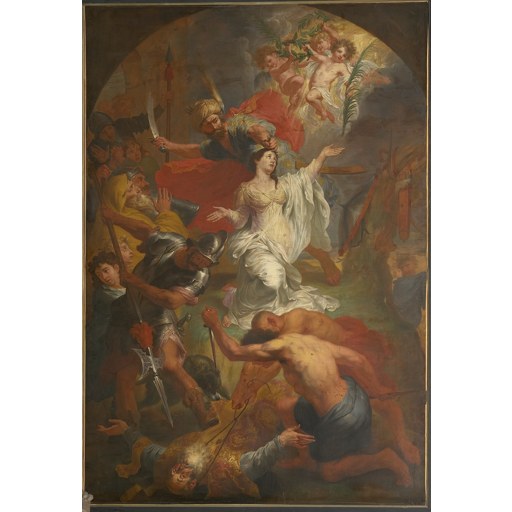
Godfried Maes
License: Public domain
Dymphna
Saint- Feast Day
- 15 May
- Gender
- female
- Church
- Catholic
Places
Relics & Where to Venerate
Housed at National Cathedral · Romania
About the National Shrine of Saint Dymphna: Visitors are welcome to view a First Class relic of Saint Dymphna when visiting the Shrine during regular hours or before and after the weekday and weekend liturgies (Wednesday mornings at 9:00am followed by Eucharistic Adoration until 4:00pm, Saturday mornings at 8:00am followed by the Novena of Our Lady of the Miraculous medal and confession until 9:00am, plus Sunday morning at 9:00 am)
Location unknown
About the National Shrine of Saint Dymphna: Visitors are welcome to view a First Class relic of Saint Dymphna when visiting the Shrine during regular hours or before and after the weekday and weekend liturgies (Wednesday mornings at 9:00am followed by Eucharistic Adoration until 4:00pm, Saturday mornings at 8:00am followed by the Novena of Our Lady of the Miraculous medal and confession until 9:00am, plus Sunday morning at 9:00 am)
Roles & Family
Patronage
mental illness;neurological disorders;nervous disorders;epilepsy;depression;anxiety;sleep disorders;incest victims;runaways;psychiatrists;psychologists;therapists;mental health professionals;families of the mentally ill;Geel
Biography
Saint Dymphna (also spelled Dympna or Dimpna) is a Christian virgin martyr whose cult is centered at Geel in present-day Flanders, Belgium. Almost nothing about her can be established from contemporary records. The principal narrative of her life is a Latin vita composed in the mid-thirteenth century by a canon named Peter (Petrus) of the church of Saint Aubert at Cambrai, writing after relics associated with the saint had come to light. That account places her in Ireland in the seventh century and presents her as the daughter of a pagan king and a devout Christian mother. Historians treat the vita as a late hagiographical legend rather than as a documentary biography: no Irish or continental source from the seventh or eighth century mentions her by name, and no verified year of birth or death survives.
According to the thirteenth-century legend, Dymphna's mother died while the girl was still young. Her father, unhinged by grief, conceived an incestuous desire to marry his daughter because she resembled her mother. Dymphna, who had been baptized a Christian and is said to have taken a private vow of virginity, refused. With the help of her confessor, the priest Gerebernus (also Gerebern), and in some versions other members of the household, she fled Ireland. The party crossed to the Continent, landed near Antwerp, and settled at Geel in Brabant. There she is described as living a life of prayer and charity, using resources she had brought with her to assist the poor and the sick. Her father eventually traced the fugitives by means of the foreign coinage they spent. At Geel he had Gerebernus killed and, when Dymphna still would not submit, struck off her head. The legend states that she was about fifteen years old at the time of her death. She is therefore venerated as an unmarried virgin martyr and is not associated with any religious order.
In the thirteenth century, sarcophagi believed to contain the remains of Dymphna and Gerebernus were discovered at Geel. The identification of the relics, the composition of the vita, and the building of a church over the site established a major local cult. Relics of Gerebernus were later translated in part to Sonsbeck in the Lower Rhine region. Dymphna's shrine at Geel attracted pilgrims seeking relief from mental and neurological afflictions. From the late Middle Ages the town developed a distinctive practice of boarding people with mental illness in local households rather than confining them, a tradition of community care historically associated with her patronage and continued, in evolving form, into the modern era. A church dedicated to her still stands at Geel, and her relics have long been venerated there. She was never the subject of a modern papal canonization or beatification; her veneration is of the pre-congregation type, resting on medieval cult, relics, and liturgical observance.
Dymphna's feast is kept on 15 May. She is widely invoked as patron of those suffering from mental illness, nervous and neurological disorders, epilepsy, depression, anxiety, and sleep disorders, as well as of psychiatrists, psychologists, therapists, other mental health professionals, and the families of the mentally ill. She is also regarded as a patron of victims of incest and of runaways, and of the town of Geel itself. Because her story is known only from a late medieval legend, some scholars have suggested a possible link or confusion with the Irish saint Damhnat (Damhnait) of Tydavnet in County Monaghan, whose cult is earlier and better anchored in Irish tradition, but the identification remains uncertain.