Eata of Hexham is a saint of the Catholic Church (d. 686). Eata of Hexham's feast day is celebrated on 26 October.
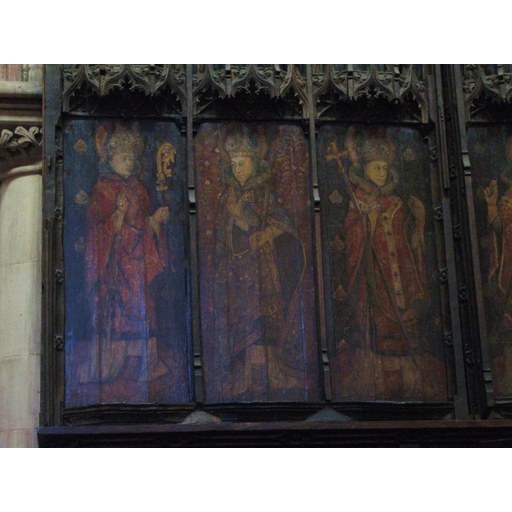
Mike Quinn
License: CC BY-SA 2.0
Eata of Hexham
Saint- Life Span
- d. 686
- Feast Day
- 26 October
- Gender
- male
- Church
- Catholic
Places
Relics & Where to Venerate
Location unknown
The bodily remains of Eata of Hexham are a first-class relic. Venerated at Hexham Abbey.
Roles & Family
Biography
Saint Eata (also called Eata of Lindisfarne or Eata of Hexham) was a seventh-century Northumbrian monk and bishop, and one of the first native Englishmen to hold high office in the church of Northumbria. Bede records that he was among the twelve English boys whom King Oswald entrusted to Saint Aidan of Lindisfarne to be raised in the monastic life and in Christian learning after Aidan’s arrival from Iona around 635. Formed in the Irish monastic tradition of Columba as practised at Lindisfarne, Eata belonged to the first generation of English disciples of the Ionan mission. Almost nothing is known of his family or exact place of birth beyond his Northumbrian English origin; later writers do not supply a birth year, and none should be inferred from the dates of his later offices.
Eata became abbot of Melrose (Mailros), a daughter-house of Lindisfarne on the River Tweed. There Saint Boisil served as prior and the young Saint Cuthbert received the tonsure and lived under Eata’s authority. When Alhfrith, sub-king of Deira, founded a monastery at Ripon, he invited Eata to establish it; Eata went with monks from Melrose, including Cuthbert as guest-master. Alhfrith, who favoured the Roman party associated with Wilfrid, soon expelled the Melrose community because they would not abandon the Irish calculation of Easter and the Celtic tonsure, and he gave Ripon to Wilfrid. Eata and his brethren returned to Melrose. After the Synod of Whitby in 664 decided for the Roman Easter, Bishop Colmán of Lindisfarne withdrew to Iona. Tuda was appointed bishop but died of plague shortly afterwards. Eata was then made abbot of Lindisfarne, remaining closely tied to Melrose; Cuthbert later became prior of Lindisfarne under him. In this way Eata governed the two principal houses of the old Ionan connection in Northumbria while conforming to the Whitby settlement.
In 678 Archbishop Theodore of Canterbury, after King Ecgfrith had driven Wilfrid from the undivided Northumbrian see, divided the diocese. Eata was consecrated bishop for Bernicia, with oversight of both Hexham and Lindisfarne. In 681 Theodore subdivided Bernicia further: Tunberht was made bishop of Hexham and Eata remained bishop of Lindisfarne. Tunberht was later deposed. In 685, when Cuthbert was elected bishop, the sees were arranged so that Cuthbert could take Lindisfarne, the monastery he preferred, while Eata was translated to Hexham. Eata therefore spent his last years as bishop of Hexham. Bede portrays him as a meek and simple man, a peaceable superior in the circle of Cuthbert, and a contrast in temperament to the more contentious Wilfrid.
Eata died in 686 and was buried in the abbey church at Hexham. He was succeeded there by Saint John of Beverley. A local cult developed at Hexham; his feast is kept on 26 October. In the twelfth century relics associated with the early bishops of Hexham, including Eata, were translated and enshrined when the church was rebuilt. He is remembered as one of Aidan’s English pupils who carried the Northumbrian church from its Irish foundations through the Easter controversy and into the diocesan order established by Theodore. Little is recorded of his inner life or of miracles in his lifetime; the historical portrait depends almost entirely on Bede’s Ecclesiastical History and related Northumbrian tradition.