Edmund of Abingdon is a saint of the Catholic Church (d. 1240). Edmund of Abingdon's feast day is celebrated on 16 November. Edmund of Abingdon is the patron saint of Abingdon;Roman Catholic Diocese of Portsmouth;St Edmund Hall, Oxford;St Edmund's College, Cambridge;St Edmund's College, Ware.
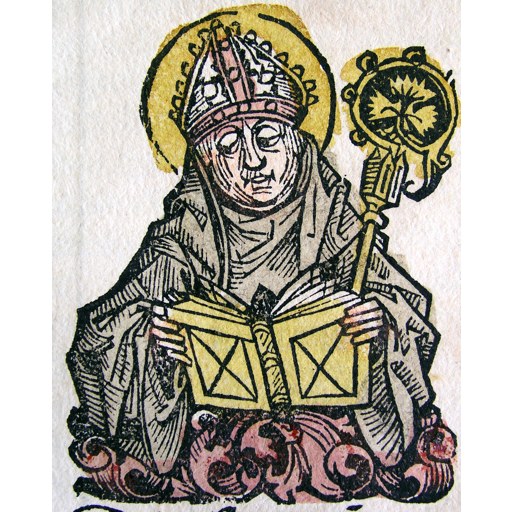
License: Public domain
Edmund of Abingdon
Saint- Life Span
- d. 1240
- Feast Day
- 16 November
- Gender
- male
- Church
- Catholic
Places
Relics & Where to Venerate
Location unknown
The bodily remains of Edmund of Abingdon are a first-class relic. Venerated at Pontigny Abbey.
Housed at Basilica of Our Lady of the Assumption · Italy
An arm is enshrined in the Chapel of Our Lady of the Assumption at St
Location unknown
After his death he was taken back to Pontigny Abbey, where his main relics are now found in a baroque reliquary tomb dating to the 17th century
Roles & Family
Patronage
Abingdon;Roman Catholic Diocese of Portsmouth;St Edmund Hall, Oxford;St Edmund's College, Cambridge;St Edmund's College, Ware
Canonization
Biography
Edmund of Abingdon, also known as Edmund Rich, was an English scholar and prelate of the late twelfth and early thirteenth centuries who became Archbishop of Canterbury. He was born in Abingdon in Berkshire. The exact year of his birth is not securely documented and is conventionally placed in the 1170s; it should not be confused with the later date of his elevation to the archbishopric. Medieval lives name his parents as Reginald (Reynold) and Mabel, and they dwell especially on his mother’s piety and austerity after she was widowed. Edmund studied the liberal arts and theology in England and at the University of Paris, then taught at Oxford, where he was among the early masters of the developing university. Contemporaries remembered him as an austere and prayerful man who combined academic work with severe personal discipline, including fasting, night vigils, and the wearing of a hair shirt.
In the 1220s he served as treasurer of Salisbury Cathedral, a post that mixed administration with pastoral responsibility. In 1233 the monks of Canterbury elected him archbishop. After hesitation he accepted, and he was consecrated in 1234. As metropolitan he sought to defend the liberties of the English Church against royal interference, coming into conflict with King Henry III over episcopal elections, taxation of the clergy, and the influence of foreign courtiers. He also tried to raise clerical discipline and to exercise authority over his suffragan bishops, which produced further friction with parts of the episcopate and with the monastic community at Canterbury.
By 1240 his position in England had become untenable. He left the kingdom intending to take his case to the papal court. He stayed at the Cistercian abbey of Pontigny in Burgundy, a house that had earlier sheltered Archbishops Thomas Becket and Stephen Langton in exile. Falling ill on the journey, he died on 16 November 1240 at Soisy-Bouy in the Île-de-France, at a house of Augustinian canons. His body was taken to Pontigny Abbey for burial. Reports of miracles at the tomb spread quickly and a cult formed around him.
Pope Innocent IV canonized Edmund in December 1246, only a few years after his death. His feast is kept on 16 November. He is honoured as patron of Abingdon and of later English Catholic institutions named for him, including the Roman Catholic Diocese of Portsmouth, St Edmund Hall at Oxford, and St Edmund’s College at Cambridge. Surviving evidence for his life consists of chronicles, letters, and hagiographical vitae written in the mid-thirteenth century; these sources agree on his learning and personal austerity while also reflecting the partisan atmosphere of Henry III’s reign and the conventions of saintly biography.