Edmund the Martyr is a saint of the Catholic Church (d. 869). Edmund the Martyr's feast day is celebrated on 20 November. Edmund the Martyr is the patron saint of England;kings;wolves;torture victims;the Roman Catholic Diocese of East Anglia;Bury St Edmunds;Suffolk.
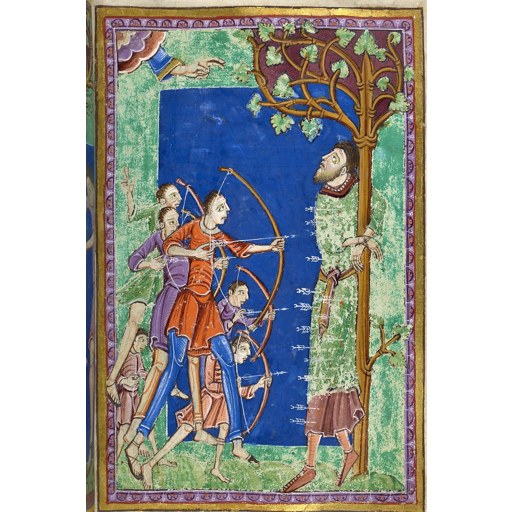
License: Public domain
Edmund the Martyr
Saint- Life Span
- d. 869
- Feast Day
- 20 November
- Gender
- male
- Church
- Catholic
Places
Relics & Where to Venerate
Location unknown
The bodily remains of Edmund the Martyr are a first-class relic. Venerated at Bury St Edmunds Abbey.
Roles & Family
Patronage
England;kings;wolves;torture victims;the Roman Catholic Diocese of East Anglia;Bury St Edmunds;Suffolk
Biography
Edmund, known as Edmund the Martyr or Saint Edmund, was king of the East Angles in the ninth century and became one of the principal royal saints of Anglo-Saxon England. Contemporary evidence for his life is extremely sparse. The chief near-contemporary notice is the Anglo-Saxon Chronicle, which records that a Danish army wintered at Thetford, that King Edmund fought against it, and that the Danes were victorious, killing the king and conquering his kingdom. The annal is dated 870 in the Chronicle; modern historians generally place the events in 869. No reliable source records Edmund’s parentage, the date or place of his birth, or the circumstances of his accession, which later medieval writers assigned to the mid-850s. He belonged to the royal house of East Anglia, a kingdom covering roughly the later English counties of Norfolk and Suffolk. Later legends that make him a son of a continental Saxon king, or that fix his birth in 841 and his coronation at fourteen, rest on twelfth-century and later compilations and are not treated as historical.
The earliest substantial narrative of his death is the Passio Sancti Eadmundi written by the French monk Abbo of Fleury around 985–987 for the monks of Ramsey. Abbo stated that he had the story from Archbishop Dunstan, who as a young man had heard it from an aged armour-bearer of the king. In this account the Danish leaders offered Edmund continued rule if he would share his kingdom and abandon Christianity. He refused both to submit and to flee. Captured, he was beaten, bound to a tree, and shot with arrows until he bristled like a hedgehog, after the manner of Saint Sebastian; still refusing to recant, he was beheaded. Abbo locates the martyrdom at a place called Haegelisdun, whose identification remains uncertain; Hoxne, Hellesdon, and several sites in Suffolk have been proposed. A famous episode in the same legend tells that a wolf guarded the severed head until searchers were guided to it by the head itself calling out.
Edmund’s body was first buried near the place of death and later translated to the royal vill of Beodericsworth, thereafter known as Bury St Edmunds. A religious community gathered at the shrine. King Cnut refounded it as a Benedictine abbey in the early eleventh century, and the house became one of the wealthiest in England. Throughout the Middle Ages Edmund was widely regarded as a patron of the English people and of English kings; his banner was carried in war, and his shrine drew royal pilgrims. The abbey church that housed the relics was among the largest in the kingdom. The shrine was despoiled at the Dissolution of the Monasteries in 1539, and the subsequent fate of the relics is unknown, though later claims have been made for fragments on the Continent and in England.
Veneration continued after the Reformation in recusant and continental Catholic circles and has been maintained in modern Anglican and Catholic calendars. His feast is kept on 20 November. He is invoked as a patron of kings, of the Roman Catholic Diocese of East Anglia, and of Bury St Edmunds and Suffolk; the wolf of the legend associated him with that animal, and the manner of his death with victims of torture. The historical Edmund remains a shadowy figure, but his martyrdom, whatever its exact circumstances, made him a lasting symbol of Christian kingship and of resistance to pagan invasion in the memory of medieval England.