Edward Colman is a blessed of the Catholic Church (1636 - 1678). Edward Colman's feast day is celebrated on 3 December.
Unknown authorUnknown author
License: Public domain
Edward Colman
Blessed- Life Span
- 1636 - 1678 (age 42)
- Feast Day
- 3 December
- Gender
- male
- Church
- Catholic
Places
Roles & Family
Canonization
Biography
Edward Colman, whose surname is also frequently given as Coleman, was an English Catholic courtier of the Restoration period and one of the earliest victims of the fabricated Popish Plot. He was born in 1636 at Brent Eleigh in Suffolk, the son of Thomas Colman, the Church of England vicar of that parish, and of Margaret, a daughter of the Waldegrave family of Lawford Hall in Essex. Raised a Protestant in a clerical household, he was educated at Trinity College, Cambridge, and took a Bachelor of Arts degree there in the late 1650s. Shortly after leaving the university he was received into the Roman Catholic Church. The conversion closed many ordinary avenues of preferment in Protestant England, but it drew him toward the Catholic-leaning circles around the court of Charles II, where the heir to the throne, James, Duke of York, was himself a Catholic.
By 1673 Colman had obtained the post of secretary to Mary of Modena, the Italian Catholic princess who had just married the Duke of York. From that office he worked with conspicuous zeal, and with little political caution, to advance the Catholic cause in England. He entered into correspondence with the papal internuncio in Brussels and with Francois de la Chaise, the Jesuit confessor of Louis XIV of France, soliciting French money and diplomatic support for English Catholics and discussing hopes for liberty of worship, Catholic appointments, and even the conversion of the king and the realm. The letters revealed an energetic Catholic political programme. They did not, in themselves, prove a conspiracy to assassinate Charles II, but copies and originals remained among Colman's papers and later proved disastrous.
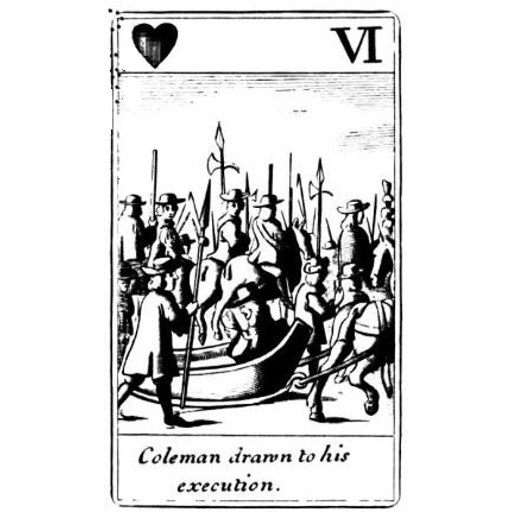
In the autumn of 1678 the informer Titus Oates laid before the Privy Council his story of a vast Jesuit plot to murder the king, burn London, and impose a Catholic regime. Colman, already known as an assertive Catholic at court, was among the first men named. His house was searched and the continental correspondence was seized. He was tried for high treason at the Court of King's Bench at the end of November 1678 before Lord Chief Justice William Scroggs. Oates and other informers gave evidence, and the letters were read to the jury. Colman denied any design against the king's life. He was nonetheless convicted. On 3 December 1678 he was hanged, drawn, and quartered at Tyburn. On the scaffold he again professed both his innocence of treason and his adherence to the Catholic faith.
Colman was one of the first Catholics put to death in the panic that followed Oates's accusations, a judicial terror that for several years cost the lives of priests and laymen later judged innocent of the plot alleged against them. The Catholic Church came to regard his death as martyrdom suffered for the faith rather than for proven treason. Pope Pius XI beatified him on 15 December 1929 together with a large group of other English and Welsh martyrs of the sixteenth and seventeenth centuries. He was not among those later canonized as the Forty Martyrs of England and Wales. He is commemorated on 3 December, the anniversary of his execution, as Blessed Edward Colman.