Efflamm is a saint of the Catholic Church (d. 512). Efflamm's feast day is celebrated on 6 November. Efflamm is the patron saint of Plestin-les-Grèves.
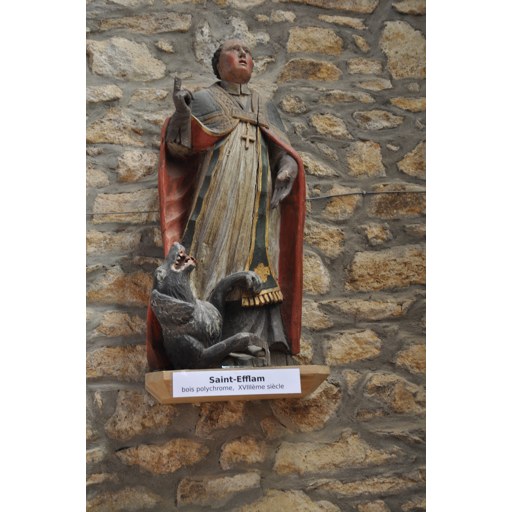
Philippe Alès
License: CC BY-SA 4.0
Efflamm
Saint- Life Span
- d. 512
- Feast Day
- 6 November
- Gender
- male
- Church
- Catholic
Places
Roles & Family
Religious Information
Patronage
Plestin-les-Grèves
Biography
Saint Efflamm, whose name is also written Efflam or Eflamm, is a saint of early medieval Brittany, commemorated above all at Plestin-les-Grèves in the Trégor (present-day Côtes-d'Armor, France). The written Life that preserves his story is late, generally assigned to the twelfth century, and was retold by early modern Breton hagiographers such as Albert Le Grand in the seventeenth century. No sixth-century document names him, so the biography cannot be verified in a modern historical sense. What can be said with confidence is that a monastic or eremitical founder was honoured from an early date at Plestin, that his feast became fixed on 6 November, and that later ages clothed that memory in a full legendary vita. Tradition makes him an Irish prince who lived in the sixth century and who died at Plestin on 6 November 512, a year that is conventional in martyrologies and local tradition rather than independently attested.
According to that legend, Efflamm was raised as a Christian and bound himself to chastity and the monastic life. His father nonetheless forced him into marriage with Enora, a princess who is herself venerated as a saint in Brittany. On the wedding night he revealed his vow and fled across the sea to Armorica, landing on the north Breton coast at the site of Plestin-les-Grèves. There he lived as a hermit. Enora later succeeded in finding him and settled as a recluse in the same district; the story insists that the marriage was never consummated and that they had no children. The episode belongs to a widespread Insular and Breton hagiographical pattern in which a royal youth escapes a dynastic marriage in order to become a monk. Whether Efflamm was in fact Irish, as the vita claims, or a Briton among the many migrants from the island of Britain to Armorica, cannot be determined from surviving evidence: Irish royal origin is a common motif in Breton saints' lives and need not be taken as historical fact.
A second famous episode links Efflamm to King Arthur. A dragon was said to ravage the broad tidal flat known as the Lieue de Grève. Arthur fought the creature in vain. Efflamm then confronted it with prayer and the sign of the cross, and the dragon cast itself into the sea and was destroyed. In gratitude Arthur granted land to the hermit. Efflamm is credited with establishing a monastery at Plestin, of which he was regarded as abbot and confessor. He is not associated with any of the later international religious orders; his community belonged to the world of early Breton, Insular-style monasticism. The Arthurian colour of the dragon story is consistent with the twelfth-century date of the vita and with Breton interest in the Matter of Britain, and it should be read as legend rather than as a datable event.
Efflamm’s cult remained essentially local. He is the patron of Plestin-les-Grèves, where the parish church and the memory of his tomb and relics formed the centre of devotion, including the traditional Breton pardon in his honour. He was neither pope nor patriarch, and there is no record of a formal papal canonization; he belongs to the large company of pre-congregational saints whose honours grew from popular and diocesan veneration. Dedications, place-names, and the persistence of the 6 November feast are the principal historical traces of his memory. Beyond Plestin and the neighbouring coast he is little known, and almost every narrative detail except the existence of the cult itself must be treated as legend rather than as verified fact.