Egwin of Evesham is a saint of the Catholic Church (d. 717). Egwin of Evesham's feast day is celebrated on 30 December. Egwin of Evesham is the patron saint of Evesham.
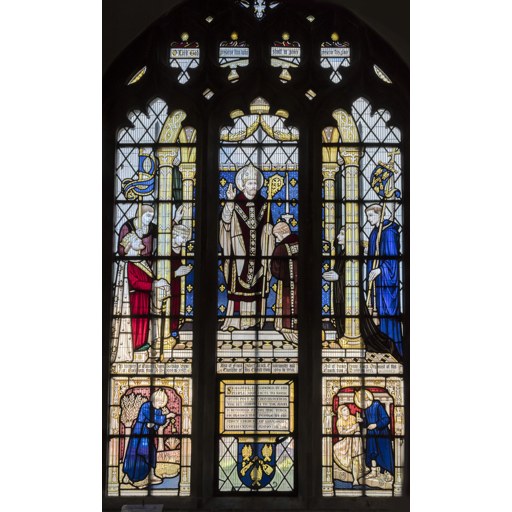
Jules & Jenny from Lincoln, UK
License: CC BY 2.0
Egwin of Evesham
Saint- Life Span
- d. 717
- Feast Day
- 30 December
- Gender
- male
- Church
- Catholic
Places
Relics & Where to Venerate
Location unknown
The bodily remains of Egwin of Evesham are a first-class relic. Venerated at Evesham Abbey.
Roles & Family
Religious Information
Patronage
Evesham
Biography
Saint Egwin (also Ecgwine or Egwine) was an Anglo-Saxon bishop of Worcester and the founder of Evesham Abbey, in the territory of the Hwicce in what is now Worcestershire. Later medieval lives, especially Evesham tradition and a vita associated with Byrhtferth of Ramsey in the early eleventh century, present him as a member of the Mercian royal kindred, related to King Æthelred of Mercia. Strictly contemporary evidence for his early life is lacking; he is historically secure as successor of Bishop Oftfor at Worcester from about 693, when the see served the Hwicce under Mercian overlordship. He remained bishop until his death and is remembered as a monastic founder rather than as a figure whose childhood or education can be reconstructed from independent eighth-century sources.
As bishop he appears in those later sources as a moral reformer who rebuked his people, particularly over marriage customs and clerical discipline. Hagiography claims that his severity provoked slander and that he went to Rome to clear his name. The best-known legend has him locking his feet in iron fetters, casting the key into the River Avon, and travelling as a penitent; a fish was then found to contain the key, taken as a sign of vindication, and Pope Constantine is said to have confirmed him in office. A Roman journey is plausible for an English bishop of this period, but the fetter-and-fish miracle follows a common hagiographical pattern and is not independently verified. Bede does not mention Egwin in this connection.
The foundation of Evesham is likewise known mainly through visionary tradition. A swineherd named Eof (the origin of the place-name Evesham, Eofeshamm) was said to have seen the Virgin Mary on a meadow by the Avon; Egwin later received a similar apparition and established a monastery there. King Æthelred of Mercia granted land, and later tradition names Coenred of Mercia and Offa of Essex among the house’s benefactors. Evesham claimed that Egwin accompanied Coenred and Offa to Rome around 709, when those kings resigned their thrones to become monks, and that Pope Constantine granted privileges to the abbey. Bede records the Roman journey of Coenred and Offa but does not name Egwin; the association remains an Evesham claim. The community came to follow the Rule of Saint Benedict and grew into one of the great abbeys of medieval England.
Egwin died on 30 December 717 and was buried at Evesham, where his tomb became a pilgrimage site. His relics were translated in the eleventh century, notably under Abbot Ælfweard around 1039. The abbey was suppressed in the sixteenth century and largely destroyed. His principal feast is 30 December; he is venerated in the Catholic Church and in Anglican calendars, and he is the patron saint of Evesham. The historical Egwin is attested as bishop of Worcester and founder of the abbey; the miracles and visions that later clustered around his name reflect medieval devotion to a founder more than a fully recoverable eighth-century biography.