Emerentiana is a saint of the Catholic Church (d. 304). Emerentiana's feast day is celebrated on January 23. Emerentiana is the patron saint of stomach ailments.
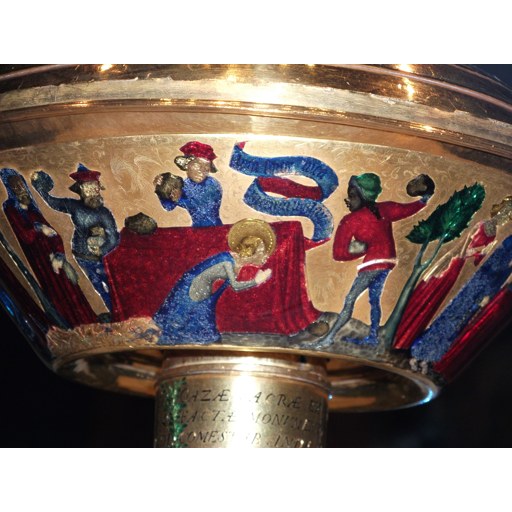
License: CC BY-SA 3.0
Emerentiana
Saint- Life Span
- d. 304
- Feast Day
- January 23
- Gender
- female
- Church
- Catholic
Places
Relics & Where to Venerate
Location unknown
The bodily remains of Emerentiana are a first-class relic. Venerated at Sant'Agnese fuori le mura.
Roles & Family
Patronage
stomach ailments
Biography
Saint Emerentiana was a Roman Christian virgin and martyr whose memory is bound up with that of Saint Agnes, the celebrated virgin martyr of the Via Nomentana. According to the Latin Acts of Saint Agnes, a legendary passion that took shape in late antiquity, Emerentiana was the daughter of the woman who had nursed Agnes and was therefore raised with her as a foster-sister in a Christian household in Rome. The two girls belonged to the generation that faced the last great imperial persecution of the Church. At the time of the events narrated in the Acts, Emerentiana had not yet been baptized; she remained a catechumen, a status that later hagiographers treated as theologically significant because her subsequent death was interpreted as a baptism of blood.
Tradition places the martyrdom of Agnes on 21 January, commonly assigned to about the year 304 during the persecution ordered by the Emperor Diocletian. A few days afterward, Emerentiana is said to have gone out to the tomb of her foster-sister, which lay along the Via Nomentana north of the city. There she prayed and publicly reproached the pagans who had killed Agnes. The crowd, still hostile to the Christian cult forming around the tomb, stoned her to death on the spot. The Roman Martyrology preserves this outline: it commemorates her as a virgin and martyr who, while still a catechumen, was stoned by pagans as she prayed at the sepulchre of Agnes.
The historical basis of the story is difficult to control. The Acts of Agnes are not contemporary and mix folklore with devotion, and Emerentiana does not appear in the Depositio martyrum of the Chronograph of 354, the earliest surviving Roman list of martyrs. Nonetheless her cult is of considerable antiquity. She is named in the Martyrologium Hieronymianum, and seventh-century pilgrim itineraries of the Roman cemeteries mention a church or memoria of Saint Emerentiana in the Coemeterium Maius on the Via Nomentana, not far from the basilica and catacomb of Saint Agnes. Relics identified as hers have long been associated with the basilica of Sant'Agnese fuori le mura. A later parish church in Rome, Santa Emerenziana, also bears her name.
In Christian art Emerentiana is typically represented as a young girl holding stones, the instruments of her martyrdom, often together with a palm or a lily, and sometimes in the company of Agnes. Devotional tradition has invoked her against stomach ailments. She was never canonized by a formal papal process of the kind that developed in the later Middle Ages; her veneration belongs to the ancient cultus of the Roman martyrs, later described as pre-congregation. The Catholic Church continues to list her in the Roman Martyrology on 23 January, two days after the feast of Saint Agnes, thereby keeping together in the calendar the two girls whom legend had already joined in life and in death.
Little can be established about her family, education, or inner life beyond what the legendary Acts supply. No reliable source records a year of birth, and even the year of death remains a conventional date tied to the Diocletianic persecution rather than a documented archival fact. What the sources do attest is a Roman cult, a burial on the Via Nomentana, and a consistent liturgical memory of a young catechumen who died at the tomb of Agnes. For the historian that combination of early cult and late narrative is typical of many Roman virgin martyrs; for the hagiographer it is the reason Emerentiana has been remembered as a companion in martyrdom and a witness to the earliest veneration of Saint Agnes.