Emmanuel Ruiz is a saint of the Catholic Church (1804 - 1860). Emmanuel Ruiz's feast day is celebrated on 10 July.
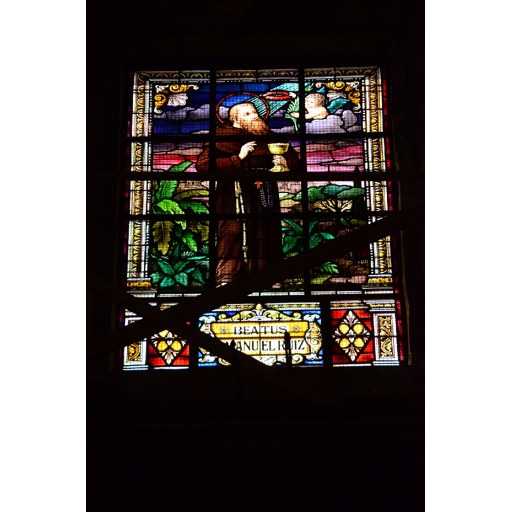
yiftah-s
License: CC BY-SA 3.0
Emmanuel Ruiz
Saint- Life Span
- 1804 - 1860 (age 56)
- Feast Day
- 10 July
- Gender
- male
- Church
- Catholic
Places
Roles & Family
Religious Information
Canonization
Biography
Emmanuel Ruiz, known in his native Spanish as Manuel Ruiz López, was a priest of the Order of Friars Minor and the guardian of the Franciscan convent in Damascus at the time of his death. He was born on 5 May 1804 in San Martín de Ubierna, a village in the province of Burgos in northern Spain. Surviving sources say little about his family, education, or the precise course of his youth. What is securely known is that he entered the Franciscan order in Spain, completed the formation required of a friar, and was ordained to the priesthood. Like many Spanish Franciscans of the nineteenth century, he was later assigned to the Custody of the Holy Land, the branch of the order that since the medieval period had been entrusted with the care of Catholic holy places and with missionary and pastoral work in Palestine, Syria, and adjacent territories of the Ottoman Empire.
In Damascus he belonged to a small community of friars attached to the convent and church of Saint Paul, in the Christian quarter near the Bab Touma gate. By 1860 he held the office of guardian, the local superior responsible for the house, its church, and those who resided there or sought its protection. The Damascus community was typical of the Custody’s smaller residences: a handful of priests, most of them Spaniards, together with the Tyrolean friar Engelbert Kolland, living among a religiously mixed urban population and serving the Latin-rite Catholic minority as well as pilgrims. Their life combined the Franciscan rule with the practical duties of a parish and hospice in a city that was an important provincial centre of Ottoman Syria.
The circumstances of his death belong to the wider massacre of Christians in Damascus in July 1860. Earlier that year, fighting between Druze and Maronite communities in Mount Lebanon had already produced great loss of life. In July the violence reached Damascus. On 9 and 10 July a mob attacked the Christian quarter, killing thousands of Christians and destroying churches, convents, and houses. The Franciscan convent was among the places stormed. Traditional accounts, drawn from the later beatification process and from Franciscan memory, hold that Father Ruiz and the seven friars with him were ordered to convert to Islam and, upon refusing, were killed in the convent and church. Three Maronite Catholic laymen—the brothers Francis, Abdel Moati, and Raphael Massabki—who had taken refuge with the friars, were put to death as well. Independent contemporary reporting confirms the massacre and the destruction in the Christian quarter, including attacks on religious houses, even though some of the more detailed hagiographical scenes of individual confrontations cannot be corroborated from non-ecclesiastical sources. The eight Franciscans and three Maronites have been commemorated together ever since as the Martyrs of Damascus.
After the riot, the remains of the slain were recovered and honour was paid to them by the surviving Christian community and by the Franciscan order. Devotion to the group spread in the Custody of the Holy Land and among Maronites in Lebanon and Syria. On 10 October 1926 Pope Pius XI beatified the eleven as a single group of martyrs. Their cause for canonization was later resumed, and on 20 October 2024 Pope Francis canonized them in Saint Peter’s Square. The Catholic Church keeps their memorial on 10 July, the date traditionally assigned to their death. Saint Emmanuel Ruiz is therefore remembered not as an isolated figure but as the superior of a small missionary community who died with his brothers and with the laymen who had sought safety under his roof during one of the gravest outbreaks of anti-Christian violence in nineteenth-century Syria.