Emmeram of Regensburg is a saint of the Catholic Church (d. 652). Emmeram of Regensburg's feast day is celebrated on 22 September. Emmeram of Regensburg is the patron saint of Regensburg;Diocese of Regensburg.
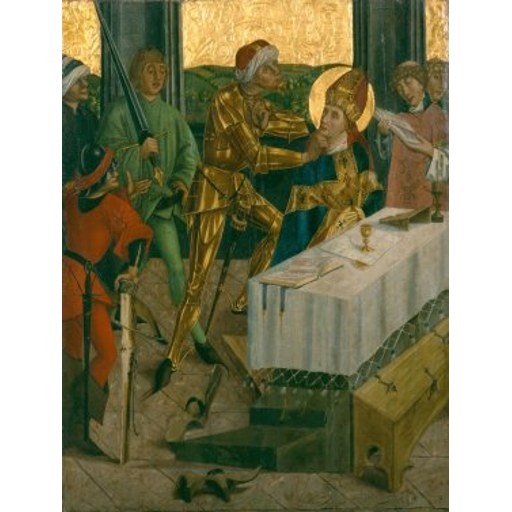
Original uploader was Imars at en.wikipedia
License: Public domain
Emmeram of Regensburg
Saint- Life Span
- d. 652
- Feast Day
- 22 September
- Gender
- male
- Church
- Catholic
Places


Relics & Where to Venerate
Location unknown
The bodily remains of Emmeram of Regensburg are a first-class relic. Venerated at St. Emmeram's Basilica.
Roles & Family
Patronage
Regensburg;Diocese of Regensburg
Biography
Saint Emmeram of Regensburg, also known as Emmeran, Emeran, or Haimhramm, was a seventh-century Christian missionary bishop and martyr, venerated above all in Bavaria. The principal narrative of his life is the Vita et passio Sancti Haimhrammi martyris, written around 772 by Arbeo (Aribo), Bishop of Freising, more than a century after the events it recounts. According to Arbeo, Emmeram was a native of Poitiers in Aquitaine and had served as a bishop there before leaving his see in order to preach among the Bavarians, who were still only partly Christian. He was received at the court of Duke Theodo in Regensburg (Ratisbon), where he spent some years preaching, baptizing, and organizing church life. Later episcopal lists sometimes count him among the early bishops of Regensburg, but the first historically secure bishop of that see is Gaubald in the eighth century; Emmeram is better understood as a missionary bishop from the Frankish west rather than as a diocesan ordinary in the later sense.
The core of the Vita is the story of his martyrdom, which medieval tradition dated to 652. Duke Theodo’s daughter Uta (Ota) became pregnant by the son of a judge. Fearing her father’s anger, she asked Emmeram’s advice. The bishop, who was preparing a pilgrimage to Rome, told her to name him as the father so that her lover might be spared; he intended later to disclose the truth and bear the blame himself. When Uta’s brother Lantpert learned of the alleged paternity, he pursued Emmeram, who had already left Regensburg. At Helfendorf (today Kleinhelfendorf, in the municipality of Aying, south of Munich) Lantpert’s men overtook the bishop, bound him to a ladder, and mutilated him, cutting off limbs, nose, and ears. Companions named Vitalis and the deacon Wolflete found him still living. At his request they carried him to Aschheim, where he died of his wounds. The year 652 is the date given in the later hagiographical and martyrological tradition; it sits awkwardly with the more secure chronology of Duke Theodo, who belongs to the late seventh and early eighth centuries, and modern historians therefore treat the precise year with caution while retaining it as the conventional date.
Emmeram was first buried at Aschheim. In the eighth century Bishop Gaubald of Regensburg translated the relics to Regensburg. A church was built over the tomb and developed into the Benedictine Abbey of St. Emmeram, which became one of the foremost monastic, cultural, and political centres of medieval Bavaria. The abbey church, later absorbed into the residence of the Princes of Thurn und Taxis, remained the focus of his cult. Emmeram’s feast is kept on 22 September. He is honoured as a patron of the city and diocese of Regensburg. He was never the subject of a formal papal canonization of the later medieval or modern type; his cult is pre-congregation, already vigorous in the eighth century.
Arbeo’s account must be read as hagiography rather than as a contemporary chronicle. It employs motifs familiar from other martyr passions, and it served the prestige of the Bavarian church and of the shrine at Regensburg. Whether Emmeram was in fact a bishop of Poitiers, whether the Uta–Lantpert story preserves a historical core, and whether 652 is the correct year remain open questions. What is well attested is an early and important cult at Regensburg and Emmeram’s lasting place among the missionary saints associated with the Christianization of old Bavaria, alongside figures such as Rupert of Salzburg and Corbinian of Freising.