Emygdius is a saint of the Pre-Schism (Universal) Church. Emygdius's feast day is celebrated on 5 August. Emygdius is the patron saint of Ascoli Piceno;Diocese of Ascoli Piceno;protection against earthquakes.
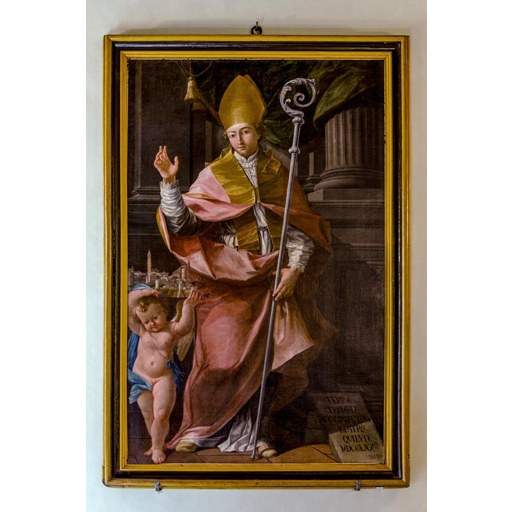
ISantesi
License: CC BY-SA 4.0
Emygdius
Saint- Feast Day
- 5 August
- Gender
- male
- Church
- Pre-Schism (Universal)
Places
Roles & Family
Patronage
Ascoli Piceno;Diocese of Ascoli Piceno;protection against earthquakes
Biography
Saint Emygdius, also known as Emidius, Emigdius, or Sant'Emidio, is venerated in the Catholic Church as a bishop and martyr associated with Ascoli Piceno in the Marche of central Italy. Almost everything reported about his life comes from later hagiographical tradition rather than from contemporary fourth-century evidence, and historians therefore treat the story with caution. According to that tradition he was born at Trier (Roman Augusta Treverorum), then a major city of the empire in what is now Germany, to a pagan family of some standing. Later writers sometimes place his birth around 279, but that year is not independently attested and should not be treated as a documented fact. As a young man he converted to Christianity. The legend states that his zeal led him to attack pagan cult images, after which he left Trier and travelled to Rome.
In Rome, according to the medieval accounts, he lodged with a man named Gratianus and miraculously cured Gratianus's paralyzed daughter and a blind man, conversions following these healings. His success in winning converts is said to have angered the urban prefect. Tradition holds that Pope Marcellus I consecrated him bishop and sent him to evangelize Ascoli Piceno (ancient Asculum in Picenum). The chronology is awkward: Marcellus's brief pontificate is usually placed in 308–309, which would leave little time for a mission and a martyrdom if both belonged to the same years. That tension is one reason scholars regard the detailed vita as a later construction built around a local martyr's cult rather than as recoverable fourth-century biography.
At Ascoli, Emygdius is said to have preached with success, converted many inhabitants, and overthrown a pagan idol. The local governor, named Polymius in the legend, had a daughter who converted under the bishop's influence and refused a marriage arranged with a pagan. Polymius then ordered Emygdius's execution. He was beheaded, together with companions whom the tradition names as Eupolus (or Euplus), Germanus, and Valentinus. The martyrdom is set in the Diocletianic persecution, with later writers giving a date around 303 or 309; neither year can be confirmed from contemporary records. His relics have long been venerated at Ascoli Piceno, above all in the crypt of the cathedral that bears his name, the Cattedrale di Sant'Emidio. Related local sites include Sant'Emidio alle Grotte and Sant'Emidio Rosso.
His feast is kept on 5 August. He is the principal patron of Ascoli Piceno and of its diocese. From the early eighteenth century his intercession was widely sought against earthquakes. After Ascoli was spared in the catastrophic central Italian earthquakes of 1703, while neighboring districts suffered heavily, devotion to him as a protector from seismic disaster spread through the Papal States and southern Italy. Churches and chapels were dedicated to him in many earthquake-prone areas, and this patronage remains the feature by which he is best known outside the Marche. A historical early bishop-martyr at Ascoli is possible and the medieval cult is well established, but the biographical particulars remain those of legend rather than of documented fourth-century history.