Ephraim of Pereyaslavl is a saint of the Catholic Church (d. 1098). Ephraim of Pereyaslavl's feast day is celebrated on 28 January.
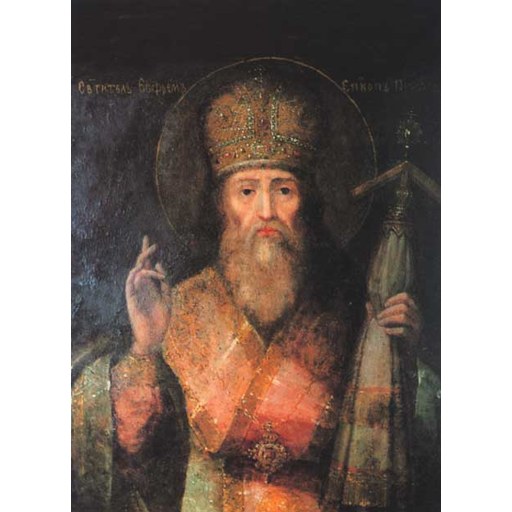
Unknown Orthodox icon painter, Ukraine
License: Public domain
Ephraim of Pereyaslavl
Saint- Life Span
- d. 1098
- Feast Day
- 28 January
- Gender
- male
- Church
- Catholic
Places
Roles & Family
Religious Information
Biography
Saint Ephraim of Pereyaslavl was an eleventh-century monk of the Kiev Caves Monastery and later bishop of Pereyaslavl in Kievan Rus'. The principal narrative sources for his life are the Kievan Caves Patericon and Nestor’s Life of Saint Theodosius of the Caves. These texts describe him as a Hungarian by origin who served at the court of Grand Prince Izyaslav I Yaroslavich of Kiev; Nestor calls him a eunuch (skopets) of the princely household. Drawn to the nascent monastic community in the caves near Kiev, he received the monastic tonsure from Saint Anthony of the Caves. The prince was angered at the loss of a courtier, but Ephraim remained in the monastery under Anthony and Theodosius.
Theodosius later sent Ephraim to Constantinople to obtain a copy of the monastic rule of the Studios Monastery, the Studite Typikon. Ephraim carried out this commission. The rule he brought back was adopted at the Kiev Caves Lavra and became the model for liturgical and cenobitic practice there, and through that house for much of later East Slavic monasticism. After his return he continued in the Caves community. In the last decades of the eleventh century he was consecrated bishop of Pereyaslavl (Pereyaslavl-Russky, on the Trubezh south of Kiev), an important eparchy of the metropolitanate of Kiev. He was already in that office by the late 1080s; the see had been held in 1072 by Bishop Peter, so Ephraim’s episcopate belongs to the period after that date.
As bishop he was remembered as a builder. In Pereyaslavl he erected a large stone cathedral dedicated to the Archangel Michael, stone defensive walls, and a stone public bathhouse, which the tradition of the chronicles and later hagiography notes as the first stone bath of its kind in Rus'. He also founded other churches and a monastic house associated with a church of Saint John. In 1091 he took part in the uncovering and translation of the relics of Saint Theodosius of the Caves, an event recorded in the Caves tradition and reflecting his continuing ties to his former monastery.
Ephraim died in 1098, according to the received hagiographical date, while still bishop of Pereyaslavl. His relics are preserved in the Near Caves (the Caves of Saint Anthony) of the Kiev Pechersk Lavra. The Eastern Orthodox Church venerates him as a hierarch. His principal feast is 28 January; he is also commemorated on 28 September with the Synaxis of the Venerable Fathers of the Kiev Near Caves, and on the Second Sunday of Great Lent with all the saints of the Caves. Precise details of his birth, the exact year of his consecration, and many acts of his episcopate are not recoverable from the surviving chronicles, and the identification of the Hungarian courtier-monk with the later bishop, though standard in Orthodox tradition, rests on the Patericon rather than on a full contemporary documentary record.