Ephrem Mtsire is a venerable of the Catholic Church (d. 1101).
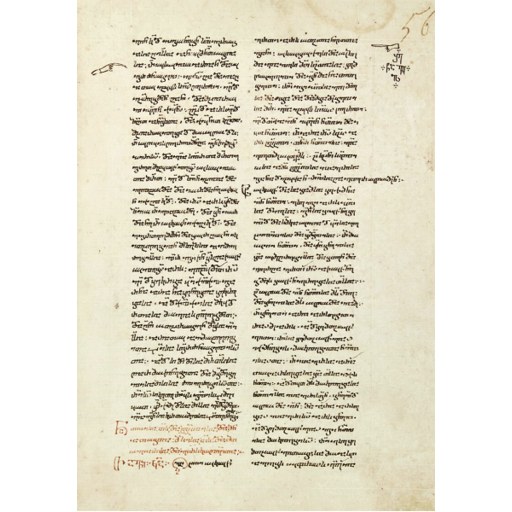
Unknown copyist
License: Public domain
Ephrem Mtsire
Venerable- Life Span
- d. 1101
- Gender
- male
- Church
- Catholic
Places
Roles & Family
Biography
Ephrem Mtsire, also known in English as Ephraim the Lesser or Ephraim the Small (Georgian: ეფრემ მცირე), was an eleventh-century Georgian Orthodox monk, theologian, philosopher, and translator. He belongs to the Hellenophile generation of Georgian ecclesiastical scholars who worked largely in the monastic colonies of the Byzantine East rather than in the Georgian kingdoms themselves. Almost nothing is recorded of his family, the place or year of his birth, or his early formation; he is known through surviving translations, prefaces, a small number of original treatises, and later Georgian literary tradition. His epithet mtsire, meaning “the small” or “the lesser,” is conventionally understood as a mark of humility, a possible physical description, or a way of distinguishing him from the much earlier and more famous Ephrem the Syrian. He should not be confused with other medieval Georgian figures who bore the name Ephrem.
Ephrem spent the productive years of his life among the Georgian monastic settlements on the Black Mountain (the Amanus or Nur range) north of Antioch in Syria, a region that in the eleventh century still belonged to the Byzantine cultural world and later passed under Seljuk and then Crusader control. Several Georgian houses existed there, among them the monastery of Kastana (also called Kalipos or Castalia in some sources), and it was in this milieu that he worked as a translator and teacher. The Black Mountain community maintained ties with the Georgian monastery of Iviron on Mount Athos and with the churches of Georgia proper, and it served as a conduit through which Greek patristic, philosophical, and canonical literature entered Georgian in a more strictly hellenizing form than had been customary in earlier centuries. His activity falls in the second half of the eleventh century, in the generation after or overlapping the later Athonite Georgian translators such as George the Hagiorite (Giorgi Mtatsmindeli).
His literary output consists chiefly of translations from Greek, accompanied by substantial prefaces in which he set out a theory of translation. He rendered into Georgian major works of John of Damascus, including the Dialectica and the Exact Exposition of the Orthodox Faith, the principal parts of the Fountain of Knowledge, thereby introducing a systematic Aristotelian logical vocabulary into Georgian theological prose. He also translated writings associated with Pseudo-Dionysius the Areopagite, homilies and theological treatises of Gregory of Nyssa and other Greek Fathers, exegetical material, and canonical collections. Unlike some earlier Georgian translators who had paraphrased freely to suit local liturgical and linguistic habits, Ephrem argued for close fidelity to the Greek original, even when that strained Georgian syntax. He discussed the difference between rendering “word for word” and “sense for sense,” and he commented on the difficulty of conveying Greek philosophical terms. These prefaces are among the most important medieval Georgian statements on language, hermeneutics, and the authority of Greek models.
In addition to translations, Ephrem composed original works of a practical and explanatory character. He wrote on the reasons for discrepancies between Georgian and Greek ecclesiastical calendars, liturgical usages, and canonical practice, seeking both to explain Georgian customs and to bring them into closer alignment with Constantinopolitan norms. He is associated with the compilation or revision of a Georgian nomocanon. His work belongs to a broader eleventh-century effort to reform Georgian church life on a Greek model and to equip Georgian clergy with the full apparatus of Byzantine theology and philosophy. Later Georgian tradition regarded him as a principal founder of the philosophical-theological school of Georgian literature, and his versions remained standard in ecclesiastical education for centuries, shaping the technical language of Georgian theology and logic.
Ephrem is generally held to have died at the beginning of the twelfth century, commonly dated around 1101 or 1103, still in the Antiochene monastic environment. By that time the First Crusade had transformed the political landscape of northern Syria, but Georgian monks continued to inhabit the Black Mountain for some time thereafter. Precise dates of birth, the names of his teachers, the exact house in which he died, and the place of his burial are not preserved in the surviving sources. Much of his biography must therefore be reconstructed from the internal evidence of his writings and from the general history of the Georgian diaspora in the Byzantine East.