Erasmus of Formiae is a saint of the Catholic Church (d. 303). Erasmus of Formiae's feast day is celebrated on 2 June. Erasmus of Formiae is the patron saint of sailors;mariners;Gaeta;Formia;against colic;against intestinal diseases;against stomach diseases;against abdominal pain;against storms at sea;women in labour.
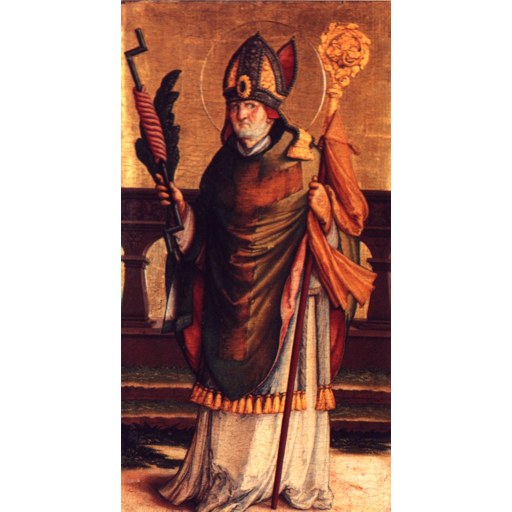
Master of Messkirch
License: Public domain
Erasmus of Formiae
Saint- Life Span
- d. 303
- Feast Day
- 2 June
- Gender
- male
- Church
- Catholic
Places


Roles & Family
Patronage
sailors;mariners;Gaeta;Formia;against colic;against intestinal diseases;against stomach diseases;against abdominal pain;against storms at sea;women in labour
Biography
Erasmus of Formiae, also known as Saint Elmo, was a Christian bishop and martyr of the late third and early fourth centuries, traditionally identified as bishop of Formiae (modern Formia) in Campania in southern Italy. Reliable contemporary documentation of his life is lacking; what can be said of him rests chiefly on later martyrologies, medieval legendaries, and the evidence of an early local cult. He is named in the Martyrologium Hieronymianum, which shows that veneration of a martyr Erasmus at Formiae was already established in late antiquity. Later tradition placed his death in the Great Persecution under the emperors Diocletian and Maximian, conventionally around the year 303. He was never a pope or a patriarch, and no religious order in the later monastic sense can be documented for him.
According to the developed hagiographical legend, Erasmus was a native of Antioch in Syria who served as a bishop and, when persecution intensified, withdrew to a hermitage on Mount Lebanon, where a raven is said to have brought him food. Discovered by imperial officials, he was subjected to torture but delivered by an angel and conveyed to Campania. There he is said to have preached and baptized many converts at Formiae. A further arrest under Maximian was followed, in the legend, by a series of spectacular ordeals—beating, confinement with serpents, boiling in oil and sulphur, and other tortures—from which he was repeatedly saved by miraculous intervention. These episodes belong to the common stock of late antique and medieval passion literature and cannot be verified as historical events. The Antiochene origin itself remains a matter of tradition rather than independent proof.
The most famous later emblem of the saint, a windlass or capstan around which his intestines were supposedly wound, is widely regarded by historians as a medieval misunderstanding. The windlass was originally a maritime attribute connected with his patronage of sailors; it was subsequently read as an instrument of martyrdom and generated the story of disembowelment. Tradition holds that Erasmus died a martyr at Formiae. His relics remained there until the ninth century. In 842, when Formia was threatened or ruined by Saracen raids, the remains were translated to nearby Gaeta, where they have been enshrined in the cathedral, of which Erasmus is a principal patron together with Saint Marcian.
In the Western church Erasmus’s feast is kept on 2 June. He became one of the Fourteen Holy Helpers, a group of saints especially invoked in the later Middle Ages against particular diseases and dangers; Erasmus was called upon in cases of intestinal and abdominal illness, colic, and the pains of childbirth, associations probably suggested by the later intestinal legend. As Saint Elmo (a form of his name that passed through Italian Ermo or Elmo), he is the patron of sailors and is invoked against storms at sea. The bluish electrical discharge sometimes seen on masts and rigging in thundery weather, known as Saint Elmo’s fire, was regarded by seafarers as a sign of his protection. He is also patron of the cities of Formia and Gaeta. His historical biography remains largely irrecoverable, but the antiquity of his cult on the Campanian coast and the breadth of his later patronage are well attested.