Éterne d'Évreux is a saint of the Catholic Church (d. 670). Éterne d'Évreux's feast day is celebrated on 16 July.
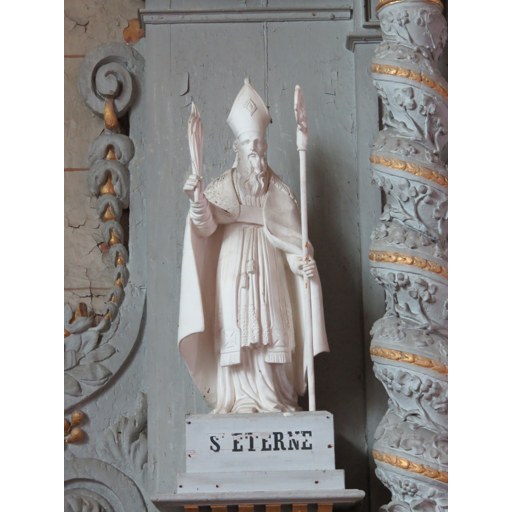
Giogo
License: CC BY-SA 3.0
Éterne d'Évreux
Saint- Life Span
- d. 670
- Feast Day
- 16 July
- Gender
- male
- Church
- Catholic
Places
Roles & Family
Biography
Saint Éterne (Latin Eternus), known in French as Éterne d’Évreux, is traditionally counted among the early bishops of the Diocese of Évreux in Neustria, in what is now Normandy. Surviving evidence places him in the seventh century, during the Merovingian period. No contemporary vita, charter, or letter in his name is known, and his date and place of birth, parentage, and education are unrecorded. Knowledge of him rests on later episcopal catalogues of Évreux, on local liturgical memory, and on the entry in the Roman Martyrology that commemorates him as bishop of Evreux in Gaul. He is commonly listed as about the seventh bishop of the see, in a succession that begins with the better-attested late-antique figures Saint Taurinus (Taurin) and Saint Gaud.
As bishop he would have held ordinary jurisdiction over the church of Évreux, a former Gallo-Roman civitas (Mediolanum Aulercorum) on the Iton. In the seventh century that office entailed the celebration of the sacraments, the discipline of clergy, the administration of church property, and the pastoral care of a mixed Gallo-Frankish population still being consolidated under Merovingian rule. No sermons, synodal acts, or miracle collections can be securely attached to him. The absence of a developed medieval legend is itself historically informative: unlike Taurinus, Éterne did not become the subject of an elaborate hagiographical romance, and his cult remained essentially diocesan.
Tradition assigns his death to 670, at or near Évreux. The precise place of burial is not established in the sources that can be verified. His feast is kept on 16 July. Recognition of his sanctity belongs to the ancient, pre-congregational veneration of local holy bishops rather than to a papal canonization of the later medieval type. No distinctive patronages of places, trades, or illnesses are documented beyond his association with the church he served. Historians therefore treat Éterne d’Évreux with caution: he is a name in the episcopal list and in the martyrology, a representative of the many Merovingian prelates whose holiness was remembered by their churches even when the particulars of their lives were lost.