Eucharius is a saint of the Catholic Church. Eucharius's feast day is celebrated on 8 December. Eucharius is the patron saint of Trier;Diocese of Trier.
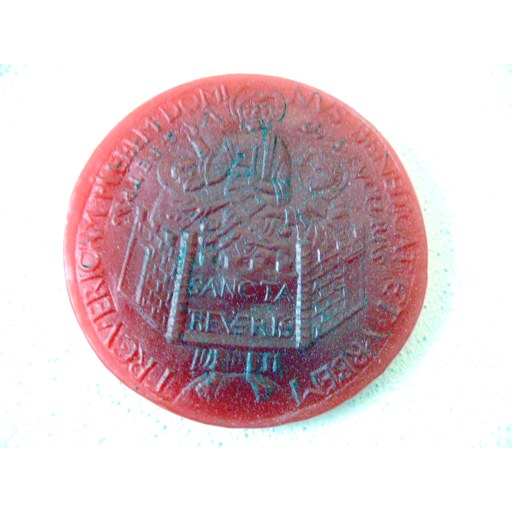
Wolfgang Sauber
License: Public domain
Eucharius
Saint- Feast Day
- 8 December
- Gender
- male
- Church
- Catholic
Places
Relics & Where to Venerate
Location unknown
The bodily remains of Eucharius are a first-class relic. Venerated at St. Matthias' Abbey.
Housed at Matthias Church · Hungary
Matthias' Abbey was originally named after Saint Eucharius, whose tomb is in the crypt, but was renamed when the abbey acquired relics of the apostle
Roles & Family
Patronage
Trier;Diocese of Trier
Biography
Saint Eucharius is venerated as the first bishop of Trier (the Roman Augusta Treverorum) on the Moselle in what is now western Germany. Almost nothing about him can be established from contemporary evidence. The traditional episcopal catalogue of Trier places him at the head of the local succession, followed by Valerius and Maternus, but the earliest bishop of the see who is securely attested in independent historical sources is Agricius, a participant in the Council of Arles in 314. On that basis later tradition assigned Eucharius to the second half of the third century; even that dating is a reconstruction rather than a fact documented in inscriptions or writings from his own lifetime. No reliable source records his birthplace, parentage, or the year of his death.
The narrative that made him famous is a legendary vita composed around the late eleventh or early twelfth century and taken up in the Gesta Treverorum. In that account Eucharius is numbered among the seventy-two disciples of Christ and is sent from Rome by the Apostle Peter, together with the deacon Valerius and the subdeacon Maternus, to preach in Gaul. After crossing the Alps the three reach the Rhine. At a place called Ellelum (commonly identified with Ehl in Alsace) Maternus dies. Eucharius and Valerius return to Peter, who gives them his pastoral staff; when the staff is laid on Maternus, already forty days in the grave, he rises from the dead. The missionaries then evangelize the Moselle and Rhine country, converting Trier and also working at Cologne and Tongeren. Eucharius is installed as bishop of Trier and is said to have governed the church there for twenty-five years. Valerius succeeds him at Trier; Maternus later becomes associated with the see of Cologne. The same cycle of stories explains the medieval relic known as the Petrusstab (Staff of Peter), long kept at Trier and afterwards at Cologne, which was believed to be the very staff Peter had entrusted to Eucharius.
Tradition locates Eucharius’s burial in a cemetery north of the Roman city, on the site that became the Benedictine Abbey of Saint Matthias. Stone sarcophagi in the abbey crypt have for centuries been shown as the tombs of Eucharius and Valerius. The church was originally dedicated to Saint John the Evangelist; it took the name of Saint Matthias after relics of that apostle were believed to have been discovered there in the twelfth century. By the High Middle Ages the cult of Eucharius was firmly established in the diocese. The Roman Martyrology commemorates him on 8 December as the first bishop of Trier. In art he appears as a bishop, sometimes with Valerius and Maternus, and sometimes holding Peter’s staff or taking part in the raising of Maternus.
Modern historians treat the Petrine mission, the identification with the seventy-two disciples, and the resurrection of Maternus as pious legend, of a kind widely used by Gallic and German churches to claim apostolic foundation. It remains possible that a bishop named Eucharius existed at Trier in the third century and that his memory was later elaborated, but no contemporary text or inscription confirms even that modest core. As the traditional founder of the see he is nonetheless honoured as a principal patron of the city and diocese of Trier, and his legend helped shape the identity of one of the oldest Christian communities north of the Alps.