Eudocia is a saint of the Catholic Church (d. 107). Eudocia's feast day is celebrated on March 1.
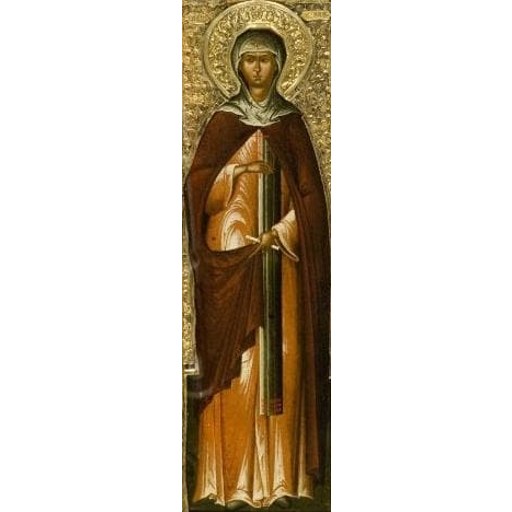
https://www.saintforaminute.com/saints/saint_eudocia_of_heliopolis
License: unknown
Eudocia
Saint- Life Span
- d. 107
- Feast Day
- March 1
- Gender
- female
- Church
- Catholic
Places
Roles & Family
Biography
Saint Eudocia, also known as Eudokia of Heliopolis, is commemorated as an early Christian martyr in the Byzantine liturgical tradition. According to the synaxaria, she was a native of Heliopolis in Phoenicia, the city corresponding to modern Baalbek in Lebanon, and lived in the time of the Roman emperor Trajan (late first and early second centuries). Of Samaritan origin and celebrated for her beauty, she is said before her conversion to have lived as a courtesan and to have gathered great wealth from those who sought her company. The narrative of her life belongs to the genre of early martyr acts and is known from later ecclesiastical compilations rather than from contemporary civic or non-Christian records.
Her conversion is ascribed to a monk named Germanus. Traveling from a monastery, he took lodging near her house and at night read aloud from the Scriptures and spoke of divine judgment. Struck with fear and repentance, Eudocia sent for him, received instruction in Christian doctrine, and was baptized by Bishop Theodotus of Heliopolis. She then distributed her fortune to the poor and to the Church and embraced a life of monastic ascesis, prayer, and fasting. In the eyes of the hagiographers she became an exemplar of radical repentance: a publicly notorious sinner who turned to baptism and the monastic life.
The traditional Passio recounts later conflicts with her former milieu. A man named Philostratus, who had known her in her earlier life, attempted to draw her back; when she refused and instead converted him, hostility followed. She was denounced as a Christian and brought before a local governor, named in the sources as Diogenes. The accounts attribute to her miracles, including the raising of the dead, which led to conversions among pagans and, in some versions, within the governor’s household. After a further period of monastic life she faced a renewed local persecution. Under a later official, often named Vicentius, she refused to offer sacrifice to the gods and was beheaded. Church tradition dates her martyrdom to the year 107.
Saint Eudocia is honored on 1 March in the Eastern Orthodox and Eastern Catholic calendars. No reliable early source records a precise burial site, and she is not associated with any later named religious order. She was never Bishop of Rome or a patriarch, and no historically documented spouse or children are attached to her name. Formal patronages of places, professions, or causes are not securely attested in the major martyrologies. Historians treat the detailed episodes of her Passio as largely legendary, while acknowledging a continuous liturgical cult of a repentant woman-martyr of Heliopolis from at least the medieval Byzantine period. Her memory has been valued in the East as a witness that no previous manner of life places a person beyond baptism, ascetic struggle, and, if required, a confessing death.