Eugenius of Toledo is a saint of the Catholic Church (d. 657). Eugenius of Toledo's feast day is celebrated on 13 November.
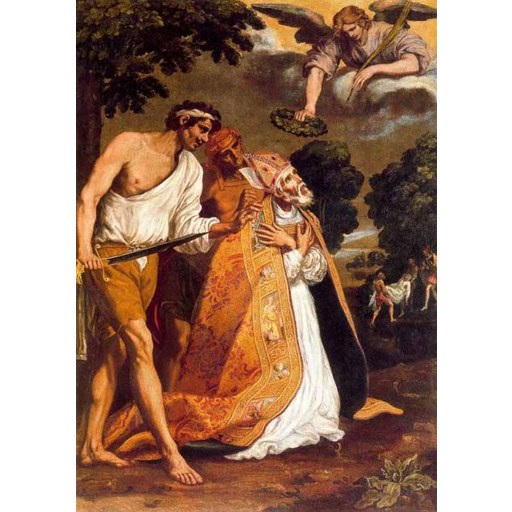
Luis Tristán
License: Public domain
Eugenius of Toledo
Saint- Life Span
- d. 657
- Feast Day
- 13 November
- Gender
- male
- Church
- Catholic
Places
Roles & Family
Biography
Saint Eugenius of Toledo, commonly distinguished as Eugenius II or Eugenius the Younger, was Archbishop of Toledo in the Visigothic Kingdom of Spain from 647 until his death in 657. He is remembered as a monk, metropolitan bishop, Latin poet, and theologian, and as one of the principal literary figures of seventh-century Iberia. He was born in Toledo to a family of Gothic stock. His successor and biographer, Saint Ildefonsus of Toledo, records that his father was named Evantius. No reliable source preserves the year of his birth. He received his early clerical formation at the cathedral of Toledo, where he served under Bishop Helladius.
Seeking a stricter religious life, Eugenius left his native city for Zaragoza. There he attached himself to Saint Braulio, bishop of Zaragoza and a leading scholar of the Visigothic church, and lived as a monk while assisting Braulio in pastoral and literary labors. Braulio intended Eugenius to succeed him in the see of Zaragoza. After the death of Archbishop Eugenius I of Toledo, however, King Chindasuinth summoned Eugenius back to the royal city and appointed him metropolitan archbishop of Toledo, the primatial see of the Visigothic church. Contemporary accounts indicate that Eugenius accepted the office with reluctance, preferring the monastic life he had found at Zaragoza.
During his decade as archbishop, Eugenius took part in the Eighth Council of Toledo in 653, the Ninth Council of Toledo in 655, and the Tenth Council of Toledo in 656. He worked to reform the clergy, to correct liturgical books and ecclesiastical chant, and to uphold doctrinal orthodoxy. Ildefonsus praises his learning, his skill in music, and his care for the worship of the church. Eugenius suffered from chronic bodily weakness and illness, a theme that appears in his own verse, yet he continued to govern the see until his death.
Eugenius was among the most accomplished Latin poets of Visigothic Spain. At the request of King Chindasuinth he revised and completed material from the Hexaemeron of the African Christian poet Dracontius, producing a recension that circulated widely in the Middle Ages. His surviving poems include epitaphs, hymns, moral pieces, and verses on his own infirmities. He also wrote on theological subjects, including the doctrine of the Trinity. His Latin style stands in the late antique Christian tradition and was valued by later medieval readers.
Eugenius died in Toledo on 13 November 657 and was succeeded by Ildefonsus, who commemorated him in the treatise De viris illustribus. He has been venerated as a saint in the Catholic Church, and his feast is kept on 13 November. His cult is of early medieval origin and does not rest on a later formal process of papal canonization in the modern sense. He remains an important witness to the intellectual and liturgical life of the Visigothic church in the seventh century.