Eurosia Fabris is a saint of the Catholic Church (1866 - 1932). Eurosia Fabris's feast day is celebrated on 8 January. Eurosia Fabris is the patron saint of mothers;large families.
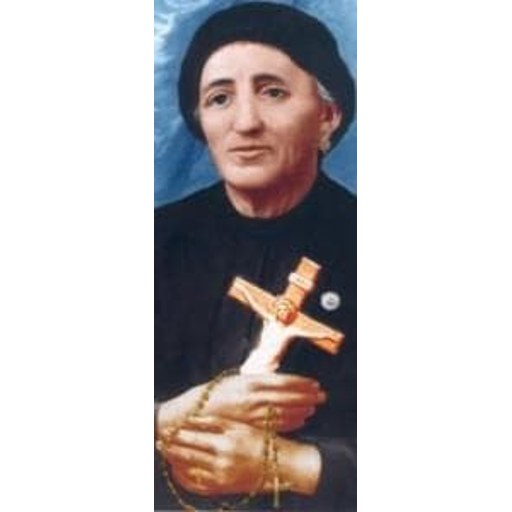
https://saintforaminute.com/blesseds/blessed_eurosia_fabris
License: unknown
Eurosia Fabris
Saint- Life Span
- 1866 - 1932 (age 66)
- Feast Day
- 8 January
- Gender
- female
- Church
- Catholic
Places
Roles & Family
Religious Information
Patronage
mothers;large families
Canonization
Biography
Eurosia Fabris, known in her lifetime and afterward as Mamma Rosa, was born on 27 September 1866 in Quinto Vicentino, in the province of Vicenza in the Veneto region of northern Italy, to Luigi Fabris and Maria Rossi, a family of peasant farmers. She was baptized the following day. When she was about four years old the family moved to the hamlet of Marola in the commune of Torri di Quartesolo, where she would spend the remainder of her life. Formal schooling was brief: she completed only the first year of elementary school before being kept at home to help with farm labor, household work, and the care of younger siblings. The parish priest later taught her to read and write and instructed her more deeply in Christian doctrine. From an early age she was regarded as devout. She attended Mass frequently, belonged to the Association of the Daughters of Mary, taught catechism to local children, and worked as a seamstress for the village.
As a young woman she set aside thoughts of entering religious life in order to remain with her family, who needed her labor. In 1886 she married Carlo Barban, a farmer of Marola. The marriage produced nine children. The couple also received into their home orphaned children of relatives, so that the household was large even by the standards of rural Veneto. Eurosia combined the ordinary work of a peasant wife—cooking, sewing, fieldwork, and the management of a crowded house—with a deliberate religious formation of her children. She became a member of the Third Order of Saint Francis and sought to live its ideals of poverty, humility, and charity in the midst of family life. Neighbors gave her the name Mamma Rosa in recognition of her maternal care, which extended beyond her own children to the sick, the poor, and anyone in need in the parish.
During the First World War she assisted soldiers and civilians who suffered from the conflict that passed through northeastern Italy. After decades of married life she was widowed in 1930 when Carlo Barban died. She spent her remaining years in prayer, in service to her grown children and grandchildren, and in continued works of charity. She died in Marola on 8 January 1932. Her reputation for holiness was already established locally; people remembered her patience, her even temper under the burdens of a large household, and her constant reference of daily difficulties to God.
The diocesan inquiry into her life and virtues was opened in the 1970s. Pope John Paul II proclaimed her Venerable on 16 December 2003, recognizing that she had practiced the Christian virtues to a heroic degree in the ordinary circumstances of lay married life. She was beatified on 6 November 2005 in Vicenza during the pontificate of Pope Benedict XVI; Cardinal José Saraiva Martins, prefect of the Congregation for the Causes of Saints, presided at the rite as papal delegate. She has not been canonized. Her feast is kept on 8 January, the anniversary of her death. She is remembered as a model of Christian motherhood, of large families, and of Franciscan spirituality lived in the world. Her remains are preserved in the parish church of Marola.