Eusebius of Rome is a saint of the Catholic Church (d. 357). Eusebius of Rome's feast day is celebrated on 14 August.
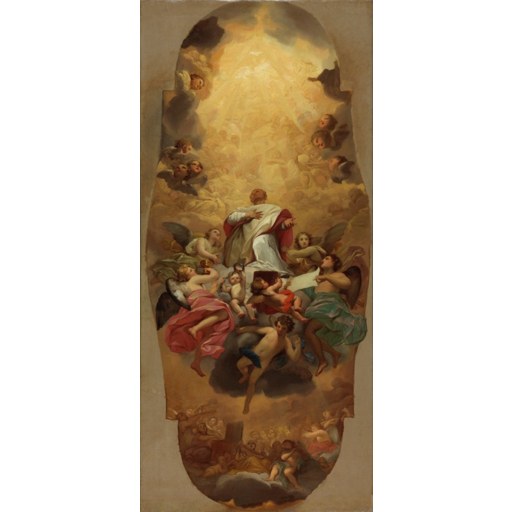
Anton Raphael Mengs
License: Public domain
Eusebius of Rome
Saint- Life Span
- d. 357
- Feast Day
- 14 August
- Gender
- male
- Church
- Catholic
Places
Roles & Family
Canonization
Biography
Eusebius of Rome was a fourth-century Christian priest of the city of Rome, venerated in the Catholic Church as a saint and martyr. He lived in the period of the Arian controversy, when the imperial court of Constantius II was deeply involved in disputes over the Nicene confession of the divinity of Christ. Almost nothing can be established from contemporary records about his family, education, or place of birth; he is known through later hagiographical tradition, through notices in the martyrologies, and through the existence of a Roman titular church that already bore his name by the end of the fifth century. He should not be confused with Pope Eusebius, who held the Roman see briefly in the early fourth century, nor with other well-known saints of the same name such as Eusebius of Vercelli.
According to the Acta Eusebii, a legendary passion of uncertain date and limited historical value, Eusebius was a determined opponent of Arianism. The narrative states that after Pope Liberius had been exiled by Constantius II and was later allowed to return to Rome—under circumstances that later Catholic tradition regarded as involving a concession to Arian or semi-Arian formulas—Eusebius continued to preach Nicene doctrine and to reproach the pope for that alleged compromise. The emperor then ordered that Eusebius be shut up in a room of his own house. There, after seven months of confinement spent in prayer, he died, an event traditionally placed in 357. Priests named Gregory and Orosius are said to have taken his body and buried it in the cemetery of Callistus on the Appian Way. The Roman Martyrology repeats the substance of this account, commemorating him on 14 August as a blessed priest who, for the confession of the faith, was imprisoned in his own house by the Arian emperor and there rested in peace.
Historians treat the Acta with caution. The chronology of Liberius’s exile (commonly dated 355–358) and of Constantius’s movements does not fit every detail of the legend, and the text shows signs of later pious elaboration. What is more securely attested is the titulus Eusebii, a Roman parish associated with a priest named Eusebius, which is documented among the titles represented at a synod in Rome in 499. The present Basilica of Sant’Eusebio all’Esquilino, on the Esquiline Hill, stands on or near the site traditionally identified as his house and remains one of the historic titular churches of Rome. Whether the founder of that titulus, the priest named in the Martyrologium Hieronymianum, and the hero of the anti-Arian legend are certainly the same person cannot be proved from the surviving evidence.
His cult is ancient and belongs to the era before formal papal canonization, when inscription in the martyrologies and local liturgical veneration constituted recognition of sanctity. He is honored as a confessor and martyr of the Roman Church, even though the precise circumstances of his death remain obscure and rest on a source that modern criticism does not regard as a straightforward historical report. No specific patronages of places, professions, or causes are securely attached to him in the standard directories of saints. His memory is preserved above all in the Roman calendar on 14 August and in the church on the Esquiline that continues to bear his name.