Eusebius of Saint Gall is a saint of the Catholic Church (d. 884). Eusebius of Saint Gall's feast day is celebrated on 31 January.
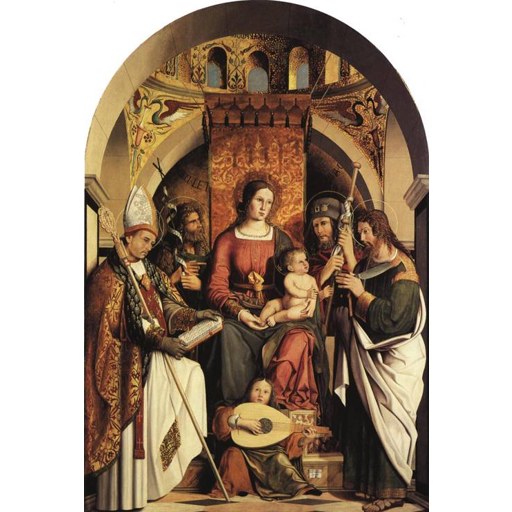
https://www.oceansbridge.com/oil-painting/art-collections/saints-collection/
License: unknown
Eusebius of Saint Gall
Saint- Life Span
- d. 884
- Feast Day
- 31 January
- Gender
- male
- Church
- Catholic
Places
Roles & Family
Religious Information
Biography
Eusebius of Saint Gall, also known in later tradition as Eusebius of Viktorsberg, was a ninth-century Irish monk, hermit, and martyr whose memory is preserved chiefly in the monastic traditions of the Abbey of Saint Gall and of the Alpine district of Vorarlberg. The year of his birth is unknown, and no lengthy contemporary vita survives. Medieval notices agree that he was a native of Ireland who left his homeland as one of the Irish peregrini of the early Middle Ages, ecclesiastics who undertook voluntary exile for the sake of religion. He made his way to the Abbey of Saint Gall in Alemannia, in present-day eastern Switzerland, a Benedictine house whose origins were bound up with the Irish missionary Saint Gall and which remained a natural destination for Irish monks throughout the Carolingian period.
At Saint Gall he lived under the monastic discipline of the Rule of Saint Benedict, which the abbey observed. After a period in community he withdrew to a stricter eremitical life. Tradition places his hermitage on Mount Saint Victor, identified with Viktorsberg in Vorarlberg, in the region of Lake Constance not far from the abbey. The pattern of profession in a cenobitic house followed by solitude still linked to that house was familiar in both Irish and Benedictine practice. In that retreat he is remembered as having given himself to prayer and asceticism rather than to public office or to writings that have come down under his name.
According to the accounts associated with Saint Gall, Eusebius met a violent death in 884, killed by a peasant who struck him with a scythe. Later legend supplied various motives for the attack, including anger at a rebuke for working on a holy day, but the early notices are brief and do not offer a full narrative or judicial record. Because of this killing he has been honored as a martyr as well as a hermit. The event belongs to local monastic memory rather than to the larger political history of the late Carolingian world, and it is known almost exclusively through that commemorative tradition.
His cult remained regional. He is commemorated on 31 January. No papal act of canonization is recorded; like most saints of the first millennium whose veneration grew from local monastic use, he belongs to the pre-congregation period of the Church’s sanctoral tradition. Later devotion connected him with Viktorsberg, where a religious house stood in subsequent centuries, and with the Abbey of Saint Gall. Beyond the outline of Irish origin, Benedictine and eremitical life, and martyrdom in 884, reliable personal details—family, education, a full itinerary, or authentic writings—are lacking. He stands as a representative of the Irish monastic diaspora on the Continent and of the eremitical strand within ninth-century Benedictine Alemannia, and his cult is a modest but persistent part of the sanctoral tradition of Saint Gall and Vorarlberg.