Eusebius is a saint of the Catholic Church (d. 310). Eusebius's feast day is celebrated on 17 August.
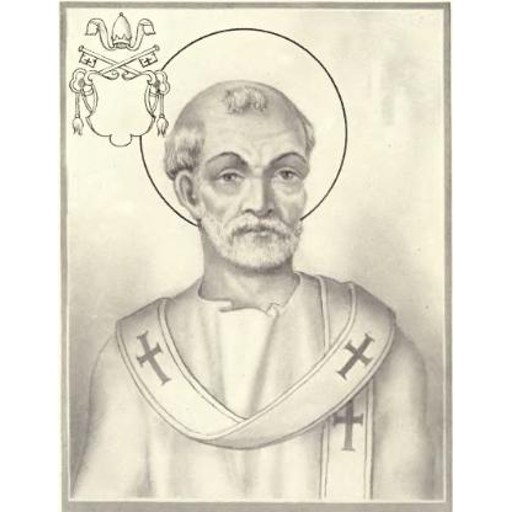
Artaud de Montor, Alexis François
License: Public domain
Eusebius
Saint- Life Span
- d. 310
- Feast Day
- 17 August
- Gender
- male
- Church
- Catholic
Places
Relics & Where to Venerate
Location unknown
The bodily remains of Eusebius are a first-class relic. Venerated at Catacomb of Callixtus.
Roles & Family
Biography
Eusebius served as Bishop of Rome in the early fourth century, in the unsettled years that followed the Great Persecution under Diocletian and during the rule of Maxentius in Italy and Africa. The Liber Pontificalis, a later and not always reliable compilation, calls him a Greek by origin. No contemporary source records the year or place of his birth, the names of his parents, or any details of his life before he occupied the Roman see. He succeeded Pope Marcellus I after an interval whose length is uncertain, and his own episcopate lasted only a few months. Standard modern reconstructions, following the Liberian Catalogue, place it from 18 April to 17 August 310, though some historians have argued for 309.
The governing issue of his pontificate was the treatment of the lapsi, those Christians who had compromised during the persecution by offering sacrifice, surrendering scriptures, or otherwise yielding to imperial pressure, and who afterwards sought to return to communion. The problem had already disturbed the Roman church under Marcellus. Eusebius upheld a moderate penitential policy: the lapsed might be reconciled, but only after they had completed a period of public penance. Opposition coalesced around a figure named Heraclius. Ancient reports do not make Heraclius’s exact demand entirely clear; he has been interpreted either as a rigorist who refused all reconciliation or as an advocate of restoration without penance. In either reading, the quarrel divided the Christian community of Rome into parties and produced public disorder serious enough to attract the attention of the civil power.
Maxentius, who then controlled Rome, intervened to end the unrest. He exiled both Eusebius and Heraclius. Eusebius was deported to Sicily, where he died in exile. Tradition assigns his death to 17 August 310. He was not executed, yet because he suffered banishment in defence of the Church’s penitential discipline and of peace among the faithful, he came to be honoured as a martyr in the broader sense of a witness. In the later fourth century Pope Damasus I composed a verse epitaph for him, stating that Heraclius had forbidden the lapsed to repent, that Eusebius had taught them to weep for their crimes, that faction had led to sedition and bloodshed, that a tyrant had driven both leaders into exile, and that the pope had kept the bonds of peace and borne exile as a testimony to the Lord.
The body of Eusebius was subsequently brought from Sicily to Rome and buried in the Catacomb of Callixtus on the Via Appia. Fragments of Damasus’s inscription have been recovered there. The mid-fourth-century Depositio episcoporum notes a commemoration of Eusebius in that cemetery. In the present Roman Martyrology his feast is kept on 17 August; an older liturgical tradition also associated him with 26 September, the date connected with his burial or translation. No religious order, marriage, children, or special patronages are attested in the surviving sources. Apart from the Greek origin claimed by the Liber Pontificalis, the outline of the lapsi conflict, the exile to Sicily, the approximate dates of his short pontificate, and the Roman burial, the historical record is silent.