Eustasius of Aosta is a saint of the Catholic Church.
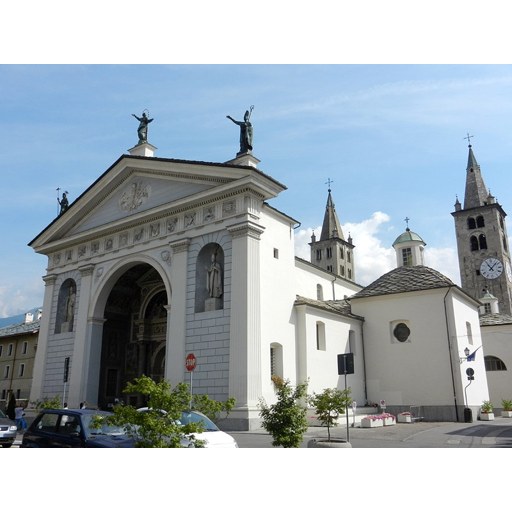
Geobia
License: CC BY-SA 3.0
Eustasius of Aosta
Saint- Gender
- male
- Church
- Catholic
Roles & Family
Biography
Eustasius of Aosta (Italian: Eustasio di Aosta) is remembered in later ecclesiastical tradition as an early bishop of the diocese of Aosta, in the Alpine valley of northwestern Italy that takes its name from the Roman colony of Augusta Praetoria. Reliable contemporary evidence for his life is extremely thin. He is known chiefly from medieval catalogs of the bishops of Aosta, compiled long after the late antique and early medieval period in which he is usually placed, and from a local cult that treated him as a holy bishop. Modern historical criticism treats such early episcopal lists with caution: they often combine names that can be corroborated from inscriptions, letters, or conciliar acts with names preserved only by liturgy or legend. No surviving letter, conciliar signature, or securely dated inscription can be attributed to Eustasius with certainty in the standard published record, and no verified year of birth or death is known.
The church of Aosta grew up along the Roman roads that crossed the Great and Little St. Bernard passes, a strategic corridor between the Po valley and Gaul. Christianity in the region is attested by late Roman and early medieval remains, and the diocese’s best-documented early saint-bishop is Gratus, generally assigned to the fifth century. Eustasius is commonly situated in the same broad horizon—the fifth century or, more loosely, the transition from the later Roman Empire to Burgundian, Ostrogothic, and Frankish rule in the western Alps. That dating is traditional rather than demonstrable from dated documents. The political and ecclesiastical setting of any Aostan bishop in that era would have included the collapse of imperial administration in the West, the reorganization of Alpine sees, and the gradual imposition of clerical discipline associated with the Gallic and Italian churches. None of those general conditions, however, yields a biography of this particular man.
Nothing verifiable is known of Eustasius’s family, birthplace, education, or the length of his episcopate. No reliable source records a spouse or children. Bishops of the period were increasingly expected to live in continence, and some were drawn from monastic life, but there is no documented proof that Eustasius belonged to a religious order or that he was married or unmarried. Claims sometimes encountered in uncritical compilations—precise years, miracle cycles, or detailed death narratives—cannot be anchored in contemporary evidence and should not be repeated as fact. His burial place is likewise unconfirmed in widely available historical literature, even though later local memory would naturally have associated a bishop of Aosta with the city’s cathedral or an early Christian cemetery.
In the Catholic Church Eustasius has been venerated as a saint, apparently through the older pattern of local episcopal cult rather than a well-documented papal canonization of the later medieval or modern type. No named pope can be shown from standard references to have canonized or beatified him, and any feast day attached to him in diocesan calendars is not securely established in the sources used here. He is not among the principal, widely attested patrons of Aosta, a role more firmly associated with figures such as Saint Gratus and Saint Ursus (Sant’Orso). His historical significance, so far as it can be stated without conjecture, is that of a name in the early succession of the see of Aosta and in the local sanctoral of the Valle d’Aosta: a reminder that the Alpine church remembered a holy bishop called Eustasius, while almost every biographical particular about him remains beyond verification.