Eustochius is a saint of the Catholic Church (d. 461). Eustochius's feast day is celebrated on 19 September.
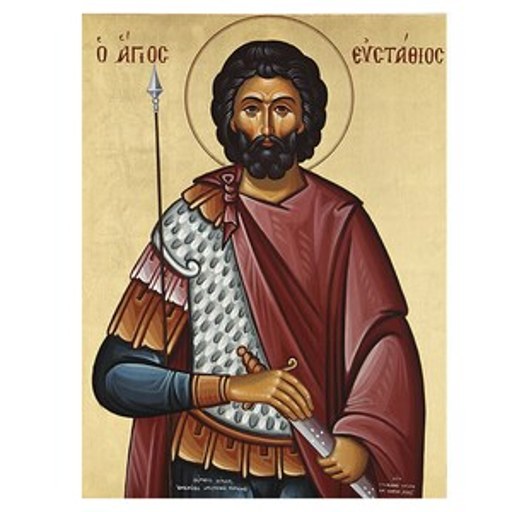
https://etsy.com/market/saint_eustace
License: unknown
Eustochius
Saint- Life Span
- d. 461
- Feast Day
- 19 September
- Gender
- male
- Church
- Catholic
Places
Roles & Family
Biography
Saint Eustochius was a fifth-century bishop of Tours in Gaul and is venerated as a saint in the Catholic Church. He is numbered as the fifth bishop of that see, succeeding Saint Brice around 443 or 444. The principal ancient source for his career is the episcopal catalogue compiled by Gregory of Tours in the late sixth century. Gregory records that Eustochius belonged to a senatorial family and that he held the bishopric for seventeen years. No contemporary document preserves the year or place of his birth, and later medieval texts do not supply those details.
His episcopate fell in the closing decades of effective Roman administration in Gaul, as Visigothic power expanded south of the Loire. In 453 he took part in the Council of Angers, a synod of bishops from western Gaul that issued canons on clerical discipline and church order. Traditional notices also credit him with the construction of churches in the territory of Tours, although Gregory of Tours does not describe those works in any detail. Beyond these points the surviving record of his pastoral activity is extremely limited.
Eustochius died in 461 and was succeeded by Saint Perpetuus, whom Gregory identifies as a kinsman and likewise a member of the senatorial aristocracy. The cult of Eustochius remained local to Tours. His feast is kept on 19 September, and he is entered in the Roman Martyrology. No writings by him are known to survive, and no formal medieval process of canonization is recorded; his status as a saint rests on the ancient episcopal cult of the church of Tours.
Because the evidence is so thin, modern historians can say little about Eustochius as an individual. He stands as one of a series of aristocratic Gallo-Roman bishops who governed the church of Tours between the age of Saint Martin and the Merovingian period. The silence of the sources concerning his early life, education, and inner character is typical of many fifth-century prelates, whose memory was preserved chiefly through liturgical commemoration and brief catalogue entries rather than through full-scale hagiography.