Euthymius the Great is a venerable of the Catholic Church (377 - 473). Euthymius the Great's feast day is celebrated on 20 January.
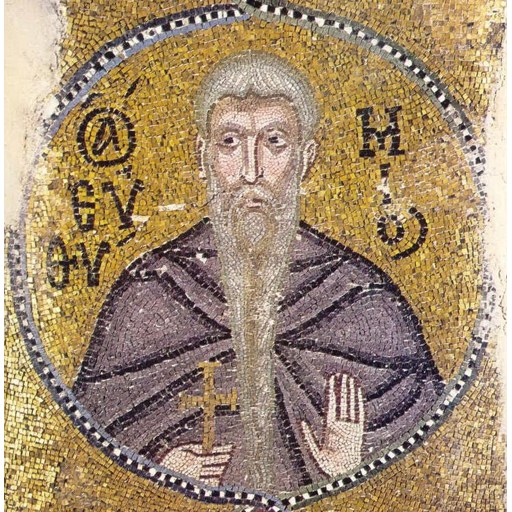
AnonymousUnknown author
License: Public domain
Euthymius the Great
Venerable- Life Span
- 377 - 473 (age 96)
- Feast Day
- 20 January
- Gender
- male
- Church
- Catholic
Places
Roles & Family
Biography
Euthymius the Great was born in 377 in Melitene, in Lesser Armenia, to a Christian family of standing. His parents, named Paul and Dionysia in the principal ancient account of his life, had long been childless and regarded his birth as a gift obtained through prayer; they dedicated the child to God. After Paul’s death, Dionysia entrusted her son to Otreius, bishop of Melitene, who oversaw his education in the scriptures and the ascetic life. Still a young man, Euthymius was ordained reader and later priest and was given responsibility for monastic communities in the diocese. Palestinian tradition presents him as already marked by austerity and a desire for solitude before he left his homeland.
In about 406 he travelled to Jerusalem as a pilgrim and then settled in the desert east of the city. He lived for a time at the laura of Pharan and formed a lasting companionship with the monk Theoctistus. The two withdrew to a cave in a remote gorge associated with Wadi Mukellik, where a coenobitic monastery grew up under Theoctistus. Euthymius himself favoured the lavriote pattern of weekday solitude and weekend common worship. He eventually established his own laura in the Judean wilderness, on the road between Jerusalem and Jericho, which became one of the leading monastic centres of fifth-century Palestine. Disciples gathered around him from Armenia, from the local population, and from among Arab tribes of the region.
Hagiographical tradition, especially the Life written by Cyril of Scythopolis in the sixth century, attributes to Euthymius numerous conversions and miracles, including healings and the provision of food and water in the desert. A well-known episode concerns the Arab sheikh Aspebetos, whose son Terebon was said to have been cured through Euthymius; Aspebetos received baptism, taking the name Peter, and later served as bishop of the Arab encampments known as the Parembole. The young Sabas, afterwards founder of the Great Laura, was among those directed by Euthymius, who sent him first to the coenobium of Theoctistus because of his youth. Euthymius thus stands at the origin of the great Judean desert monastic network of the later fifth and sixth centuries.
In the doctrinal conflicts of his age Euthymius upheld the Christology of the Council of Chalcedon of 451. He had earlier opposed Nestorian teaching and, after Chalcedon, resisted the anti-Chalcedonian current that found support in parts of Palestine and at the imperial court. The empress Eudocia, residing in the Holy Land and at one time sympathetic to the opponents of Chalcedon, is reported to have been moved toward the conciliar definition through contact with Euthymius. He remained a priest and abbot rather than a bishop, but his spiritual authority made him a point of reference for patriarchs of Jerusalem and for pilgrims and officials.
Euthymius died on 20 January 473 in his laura, at an advanced age given in the sources as about ninety-six. Patriarch Anastasius of Jerusalem took part in his burial within the monastery. The laura continued as a Chalcedonian stronghold. His memory is kept on 20 January in the Eastern Orthodox and Roman Catholic calendars. The Life by Cyril of Scythopolis, composed within living memory of the saint’s disciples, remains the chief narrative source; later synaxaria and menologia depend largely on that text. Euthymius is honoured as a founder of Palestinian monasticism and a defender of Chalcedonian orthodoxy, without having held episcopal or patriarchal office.