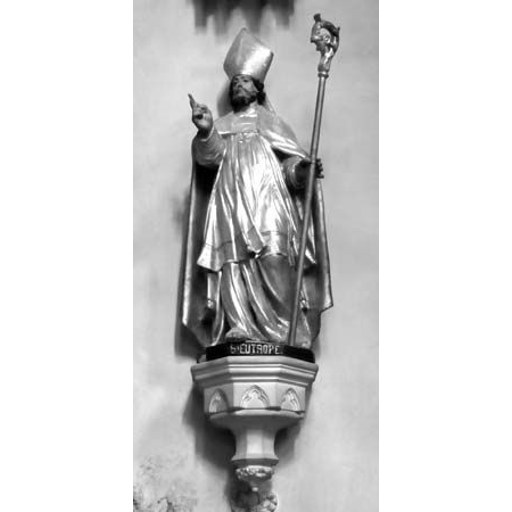
Eutropius is a saint of the Catholic Church. Eutropius's feast day is celebrated on 30 April. Eutropius is the patron saint of Saintes.
https://www.britannica.com/biography/Saint-Eutropius-of-Saintes
License: unknown
Eutropius
Saint- Feast Day
- 30 April
- Gender
- male
- Church
- Catholic
Places
Roles & Family
Patronage
Saintes
Biography
Saint Eutropius, known in French as Saint Eutrope, is venerated as the first bishop of Saintes (ancient Mediolanum Santonum) in Roman Aquitania, in what is now western France, and as a martyr of the early Church. No contemporary biography survives, and neither a year of birth nor a year of death can be established from reliable sources. The earliest substantial witness is Gregory of Tours in the sixth century, who states that Eutropius was the first to hold the episcopal see of the Santones and that he suffered martyrdom. Gregory also repeats a tradition that Eutropius had been ordained and sent into Gaul by Pope Clement I. That claim is chronologically impossible if taken literally, since Clement belongs to the late first century, and modern historians generally place the Christian mission at Saintes, and therefore Eutropius’s activity, in the third century rather than in the apostolic age. Place of birth is likewise unknown: later legend variously makes him a Roman or a man of Eastern, even Persian, origin, but these details are not independently verified.
Medieval hagiography greatly enlarged the story. A Passion of Saint Eutropius, circulating in the high Middle Ages, presents him as a convert of noble or even princely stock who was instructed at Rome and dispatched to Gaul as part of the legendary “apostolic” mission associated with figures such as Denis of Paris. At Saintes he is said to have preached with only limited early success, to have converted a young woman named Eustella (Eustelle), described as the daughter of a local ruler or governor, and at last to have been killed by pagans who split his skull with an axe or similar weapon. These episodes belong to legend rather than to recoverable history, yet they determined his later iconography: he is typically shown as a bishop with an axe or with a wounded head. Nothing certain is known of his family, of any marriage, or of children. He belongs to the age of the early missionary episcopate and is not recorded as a member of a later religious order.
The cult at Saintes is ancient and historically better attested than the biography. Eutropius’s tomb became a pilgrimage site. In the eleventh century a major Romanesque church, the Basilica of Saint-Eutrope, was raised over the crypt that contained his relics; the church was associated with a Cluniac priory and stood on routes linked to the pilgrimage to Santiago de Compostela. The relics remained an object of veneration through the Middle Ages. The Roman Martyrology keeps his feast on 30 April. He is the patron of the city of Saintes. Local devotion also attached healing significance to a spring near the shrine. Formal papal canonization in the later juridical sense does not apply to so early a cult; recognition grew by local veneration and eventual wider liturgical acceptance. He was neither pope nor patriarch.
Several other historical or legendary figures bear the name Eutropius, including a fifth-century bishop of Orange and various martyrs listed in Eastern and Western calendars. The present account concerns the first bishop of Saintes, who is the principal Western saint of that name. The gap between Gregory’s brief notice, the later Passion, and the archaeological and architectural reality of the shrine at Saintes should be kept in view: the man is historically plausible as an early missionary bishop and martyr of Aquitania, while almost every picturesque detail of origin, companions, and manner of death remains in the realm of medieval legend rather than of verified fact.