Eutychian is a saint of the Catholic Church.
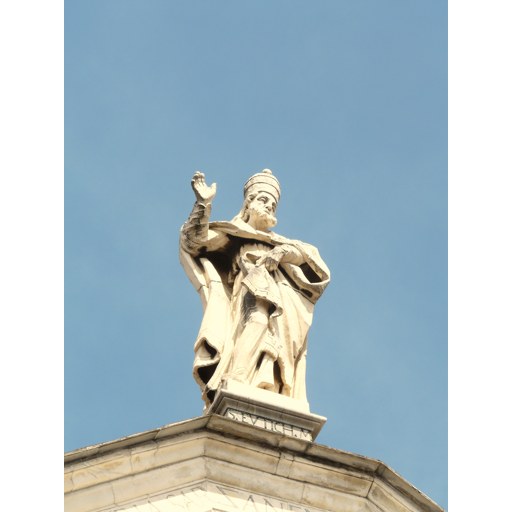
Davide Papalini
License: CC BY-SA 3.0
Eutychian
Saint- Gender
- male
- Church
- Catholic
Biography
The historical individual named Eutychian remains poorly attested in the surviving literature of early and medieval Christianity. The name itself, a Latinized form of Greek Eutychianos and built on the root eutychēs (“fortunate”), was borne by a number of clerics and lay Christians in the Roman world, especially from the third through the sixth centuries. Distinguishing one bearer of the name from another is frequently impossible when only a name, a brief martyrological notice, or a later catalogue entry survives. No contemporary chronicle, authentic vita, or securely attributed episcopal list has been matched to this particular figure, so a personal biography cannot be reconstructed from reliable sources.
Among better-documented persons sharing the name or a close variant is Pope Eutychian (Eutychianus), Bishop of Rome in the later third century, whose short pontificate is recorded in the Liber Pontificalis and whose death is traditionally placed in 283. Other homonymous saints appear in regional calendars as martyrs or as bishops of lesser Italian or Eastern sees. Medieval compilers of legendaries and martyrologies sometimes merged or confused these traditions, transferring passion accounts or miracles from one Eutychius or Eutychianus to another. Conflation of this kind is a well-known hazard and makes it unsafe to assign any of those better-known careers to the present subject.
No reliable ancient or medieval source supplies a birthplace, family origin, or precise dates for this Eutychian. It is likewise unknown whether the person held episcopal or patriarchal office, belonged to a monastic community, suffered martyrdom, or was commemorated by a stable liturgical cult with a fixed feast day. Later local traditions sometimes preserve feast days for saints of this name, but they cannot be assigned with certainty in the absence of a clear identification.
Consequently, claims regarding patronage over places, professions, illnesses, or groups, as well as any formal process of canonization or beatification, cannot be substantiated. The figure stands as one of many early Christian names whose historical reality is probable but whose personal story has not been preserved in sufficient detail for a full biography. Scholars of late antique hagiography therefore treat such entries with caution and prefer to leave biographical fields blank rather than risk transferring data from a different homonym.