Eutychius is a saint of the Catholic Church (d. 582). Eutychius's feast day is celebrated on April 6.
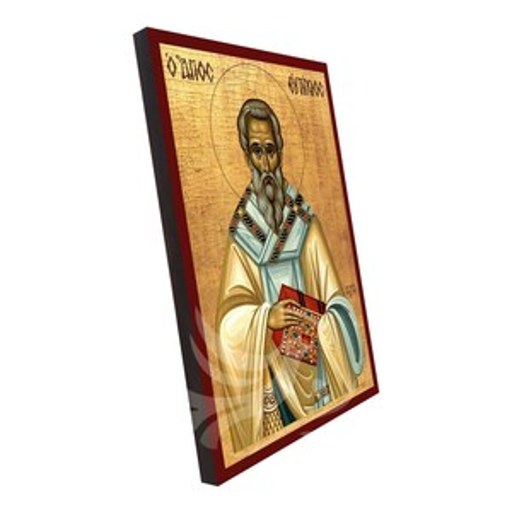
https://www.etsy.com/listing/1845010626/saint-eutychius-patriarch-of
License: unknown
Eutychius
Saint- Life Span
- d. 582
- Feast Day
- April 6
- Gender
- male
- Church
- Catholic
Places
Roles & Family
Biography
Saint Eutychius was a sixth-century patriarch of Constantinople, holding the see from 552 to 565 and again from 577 until his death in 582. He was born at Theium in Phrygia, in the early sixth century. His father, Alexander, served as a military officer of respectable rank. As a young man Eutychius was sent to Constantinople for his education. He then entered monastic life at Amasea in Pontus, was ordained, and became archimandrite of his monastery. In 552 he was present in the capital as a representative of the metropolitan of Amasea when Patriarch Menas died. The Emperor Justinian I, seeking a patriarch who would support imperial policy in the controversy over the Three Chapters, had Eutychius appointed to the see of Constantinople.
Soon after his consecration Eutychius presided at the Second Council of Constantinople, the fifth ecumenical council, which assembled in 553. The council condemned the so-called Three Chapters: certain writings of Theodore of Mopsuestia, writings of Theodoret of Cyrrhus directed against Cyril of Alexandria, and the letter of Ibas of Edessa to Maris. The assembly thus ratified Justinian's ecclesiastical policy and deepened a rift with some churches in the West, a rift in which Pope Vigilius was himself entangled. Eutychius's first patriarchate was otherwise spent in the administration of the church of the imperial city under the close supervision of the court.
In the last years of Justinian the emperor favored aphthartodocetism, the teaching associated with Julian of Halicarnassus that the body of Christ was incorruptible from the Incarnation and not only after the Resurrection. Eutychius refused to subscribe to this doctrine. In 565 he was deposed and replaced by John III Scholasticus. He was sent into exile and spent many years at his former monastic home in the region of Amasea, remaining there through the death of Justinian in 565 and into the reign of Justin II. The principal narrative source for his life is the biography written by his chaplain Eustratius, which portrays him as doctrinally steadfast and attributes miracles to him during the years of banishment.
After John Scholasticus died in 577, Justin II restored Eutychius to Constantinople. During this second patriarchate a dispute arose with Gregory, the papal apocrisiarius in the capital and later Pope Gregory I, over the qualities of the resurrected body. Eutychius argued that the risen body would be subtler than air and no longer palpable; Gregory, appealing to the Gospel accounts of the risen Christ, insisted that it would remain palpable. Gregory later wrote that Eutychius, as he was dying, rejected the disputed treatise and accepted that the resurrection body is palpable. Eutychius died in Constantinople in 582. The Byzantine liturgical tradition and the Roman Martyrology commemorate him on 6 April. His cult belongs to the ancient veneration of holy bishops rather than to any later formal process of canonization.