Evangelist John is a saint of the Catholic Church. Evangelist John's feast day is celebrated on 27 December (Western); 26 September (Eastern). Evangelist John is the patron saint of writers;authors;theologians;publishers;booksellers;editors;printers;papermakers;typesetters;bookbinders;engravers;lithographers;painters;artists;art dealers;scribes;against poisoning;poison victims;against burns;burn victims;friendship;Asia Minor;Turkey;Umbria.
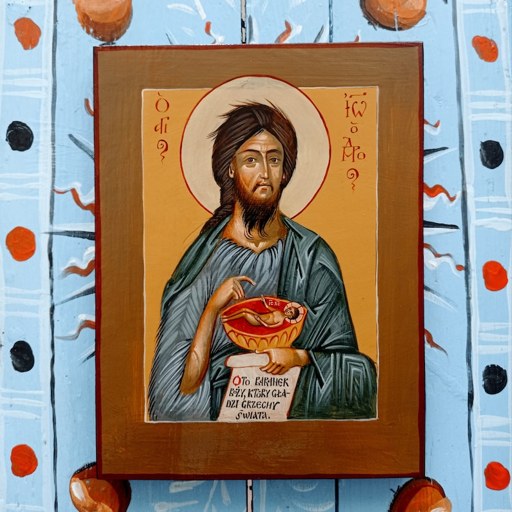
https://www.etsy.com/uk/listing/1518487637/saint-john-the-baptist-picture-icon
License: unknown
Evangelist John
Saint- Feast Day
- 27 December (Western); 26 September (Eastern)
- Gender
- male
- Church
- Catholic
Places
Roles & Family
Patronage
writers;authors;theologians;publishers;booksellers;editors;printers;papermakers;typesetters;bookbinders;engravers;lithographers;painters;artists;art dealers;scribes;against poisoning;poison victims;against burns;burn victims;friendship;Asia Minor;Turkey;Umbria
Biography
John, known in Christian tradition as John the Apostle and John the Evangelist, is identified in the New Testament as the son of the Galilean fisherman Zebedee and as the brother of James, later called James the Greater. His mother is commonly identified with Salome, one of the women who followed Jesus. The Synoptic Gospels describe Jesus calling the two brothers from their father’s boat on the Sea of Galilee; they left their nets and became among the first disciples. Together with Simon Peter they formed an inner circle present at the raising of Jairus’s daughter, at the Transfiguration, and at the agony in Gethsemane. The Fourth Gospel never names its author, but from the later first and second centuries Christian writers—including Irenaeus of Lyons, who claimed a chain of memory through Polycarp of Smyrna—identified the unnamed disciple whom Jesus loved with John the son of Zebedee. That identification, though questioned by much modern historical criticism, has remained the dominant ecclesiastical tradition in both East and West.
In the Fourth Gospel the beloved disciple reclines beside Jesus at the Last Supper, stands at the foot of the cross, and receives from the dying Jesus the care of Mary, Jesus’s mother. He runs with Peter to the empty tomb and later recognizes the risen Lord at the Sea of Tiberias. The Acts of the Apostles still pairs him with Peter in Jerusalem, in preaching, healing, and appearance before the Sanhedrin. After the period covered by Acts, second-century witnesses such as Irenaeus, Polycrates of Ephesus, and Clement of Alexandria place him in Asia Minor, living and teaching at Ephesus and surviving into the reign of the emperor Trajan in the late first and early second century. A related tradition, already known to Tertullian, held that he was taken to Rome and plunged into boiling oil before the Latin Gate, from which he emerged unharmed, and that he was afterward exiled to the island of Patmos, where the Book of Revelation locates a visionary named John. Whether the apostle, the evangelist, the seer of Patmos, and the John the Presbyter mentioned by Papias are one person or several remains a question of historical scholarship; hagiographical tradition has generally treated them as a single figure.
Church writers from the second century onward attributed to him the Gospel according to John, the three Johannine epistles, and the Apocalypse. These works present a high Christology, the language of light, life, and word, and the commandment of mutual love, which earned him the title the Theologian in the Greek East and the Apostle of Love in the Latin West. Tradition further holds that he remained unmarried—Eastern liturgy styles him the Virgin—and that he died a natural death at an advanced age in Ephesus, the only one of the Twelve not to suffer martyrdom in the strict sense. A tomb venerated as his was already a pilgrimage site in late antiquity; in the sixth century the emperor Justinian built over it the great Basilica of St. John, whose ruins still stand near modern Selçuk in western Turkey.
Precise years of birth and death cannot be verified from contemporary records. His principal feast in the Roman calendar is 27 December; the Byzantine tradition commemorates his repose on 26 September and, on 8 May, a miracle associated with dust or manna from his tomb. A Western commemoration of St. John before the Latin Gate (6 May) recalled the boiling-oil legend. In Christian art his symbol is the eagle, drawn from the four living creatures of Ezekiel and Revelation and from the soaring prologue of the Fourth Gospel; he is also shown with a chalice, sometimes with a serpent, for the legend of a poisoned cup drunk unharmed after a blessing. He is invoked as patron of writers, theologians, booksellers, publishers, editors, printers, papermakers, and related crafts, and against burns and poisoning. While modern scholarship continues to debate the authorship of the Johannine corpus and the unity of the figure behind it, the contour of his remembered life—Galilean fisherman, intimate of Jesus, witness of the Passion and Resurrection, teacher in Asia, and aged witness at Ephesus—has shaped Christian memory from the second century to the present.