Evangelist Luke is a saint of the Catholic Church. Evangelist Luke's feast day is celebrated on 18 October. Evangelist Luke is the patron saint of physicians;surgeons;artists;painters;iconographers;notaries;butchers;bookbinders;brewers;glass workers;goldsmiths;lacemakers;sculptors;stained-glass workers;bachelors;students;hospitals.
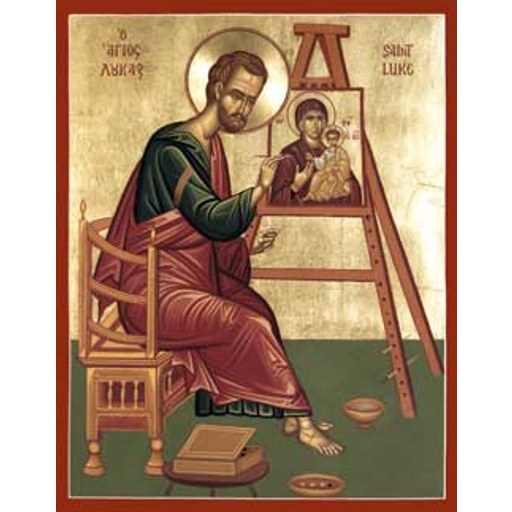
https://archangelsbooks.com/products/saint-luke-the-evangelist-painting-icon-the-first-iconographer
License: unknown
Evangelist Luke
Saint- Feast Day
- 18 October
- Gender
- male
- Church
- Catholic
Places
Roles & Family
Patronage
physicians;surgeons;artists;painters;iconographers;notaries;butchers;bookbinders;brewers;glass workers;goldsmiths;lacemakers;sculptors;stained-glass workers;bachelors;students;hospitals
Biography
Luke the Evangelist is traditionally identified as the author of the Gospel of Luke and the Acts of the Apostles, a two-volume work that forms a large part of the New Testament. Within the New Testament he is named as a physician and as a companion of the Apostle Paul. The Epistle to the Colossians refers to him as the beloved physician, and he is also mentioned in the Epistle to Philemon and in the Second Epistle to Timothy, where Paul writes that only Luke is with him. The so-called we passages in Acts, in which the narrative shifts to the first person plural, have long been read as indicating that the author traveled with Paul on portions of his missionary journeys. From the late second century onward, Christian writers including Irenaeus of Lyons, the Muratorian Fragment, Eusebius of Caesarea, and Jerome attributed both the Third Gospel and Acts to Luke.
According to Eusebius, Luke was by race an Antiochene and a physician by profession. He is generally taken to have been a Gentile Christian rather than a Jew, a conclusion drawn in part from Colossians 4, where Paul lists certain companions as being of the circumcision and then names Luke separately. He was not one of the Twelve Apostles. The prologue to the Gospel of Luke states that the author was not an eyewitness of the events of Jesus's ministry but had followed all things closely for some time and undertook to write an orderly account based on the traditions of those who were eyewitnesses and ministers of the word. The Gospel that bears his name is distinguished by its attention to the poor and marginalized, to women, to Samaritans and Gentiles, and by parables unique to it, including those of the Good Samaritan and the Prodigal Son. His writings show familiarity with Hellenistic literary conventions and with medical vocabulary, consistent with the tradition of his profession.
Luke's later career and death are known only from later ecclesiastical tradition, which is not uniform. He is believed to have accompanied Paul from the region of Troas and Macedonia onward and to have remained with him during periods of imprisonment. An early Gospel prologue and later writers such as Jerome associate his death with Boeotia and give his age as eighty-four; other traditions name Thebes in Boeotia or, less commonly, Patras in Achaia. Some later accounts describe him as a martyr, while others imply a peaceful death. There is no contemporary evidence that he held episcopal office, and claims that he was bishop of a particular see belong to later legend. Whether he married is not recorded in the New Testament; an early prologue states that he served without a wife, but this cannot be independently verified.
From an early date Luke was counted among the four Evangelists and was associated, after Irenaeus, with the symbol of the winged ox or calf drawn from the four living creatures of Ezekiel and Revelation. A tradition especially cultivated in the Christian East held that he was a painter and that he produced the first images of the Virgin Mary holding the Child Jesus; though this is not found in the earliest witnesses, it established him as a patron of artists and iconographers. His relics were said to have been translated to Constantinople in the fourth century. A body long identified as his is venerated in the Basilica of Santa Giustina in Padua, and a head relic is kept in the Cathedral of Saint Vitus in Prague. The churches of East and West keep his feast on 18 October. He is widely invoked as patron of physicians, surgeons, and artists, as well as of notaries, butchers, and a number of crafts connected with books, glass, and metalwork.