Evangelist Mark is a saint of the Catholic Church. Evangelist Mark's feast day is celebrated on 25 April. Evangelist Mark is the patron saint of Venice;Egypt;Alexandria;lawyers;barristers;notaries;secretaries;interpreters;stained-glass workers;glaziers;prisoners;lions;Aquileia.
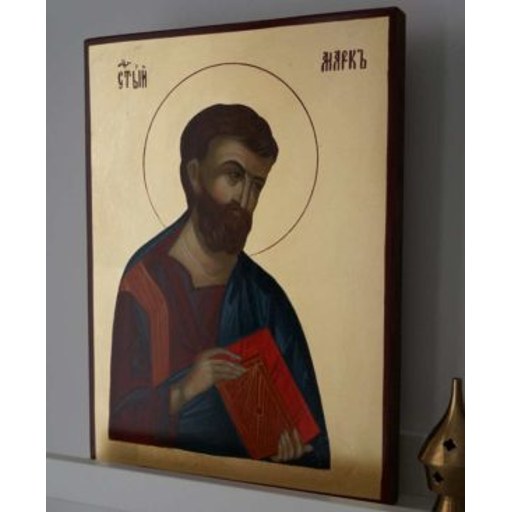
https://www.blessedmart.com/shop/hand-painted-icons/male-saints-icons/st-mark-apostle-and-evangelist/
License: unknown
Evangelist Mark
Saint- Feast Day
- 25 April
- Gender
- male
- Church
- Catholic
Places
Roles & Family
Patronage
Venice;Egypt;Alexandria;lawyers;barristers;notaries;secretaries;interpreters;stained-glass workers;glaziers;prisoners;lions;Aquileia
Biography
Mark the Evangelist is the traditional author of the Gospel of Mark, generally regarded by modern scholars as the earliest of the four canonical Gospels and usually dated to the second half of the first century. In the New Testament he is commonly identified with John Mark, a Jewish Christian whose mother Mary kept a house in Jerusalem that served as a meeting place for the early community (Acts 12:12). John Mark accompanied Barnabas and Paul on the first missionary journey as far as Perga in Pamphylia, where he left them and returned to Jerusalem, an episode that later caused a sharp disagreement between Paul and Barnabas (Acts 13:5, 13; 15:36–39). Later New Testament letters present him as a valued coworker: Paul names him among those with him in Rome (Colossians 4:10; Philemon 24) and asks Timothy to bring him because he is useful for ministry (2 Timothy 4:11). The First Letter of Peter, written from “Babylon” (commonly understood as Rome), refers to “Mark, my son” (1 Peter 5:13), a phrase that ancient Christian writers took as evidence of a close relationship with the apostle Peter.
The earliest extra-biblical testimony comes from Papias of Hierapolis in the early second century, as preserved by Eusebius of Caesarea. Papias reported that Mark had been Peter’s interpreter and wrote down accurately, though not in order, what he remembered of the Lord’s words and deeds as Peter had related them. Irenaeus of Lyons, Clement of Alexandria, Origen, and Jerome repeated and developed this tradition, locating the composition of the Gospel in Rome in connection with Peter’s preaching. Whether the John Mark of Acts is certainly identical with the evangelist remains a matter of scholarly discussion, but the identification was standard in the ancient Church and remains the basis of liturgical and hagiographical tradition.
Later tradition, especially as preserved in the Coptic Church, holds that Mark was born in Cyrene in the Pentapolis of North Africa to a Jewish family that subsequently moved to Palestine. That Cyrene origin is not attested in the New Testament and belongs to later hagiography. After his association with Peter and Paul, he is said to have evangelized in Egypt and founded the Church of Alexandria, becoming its first bishop. Eusebius states that Mark was the first to preach the Gospel in Egypt and established churches in Alexandria, and that Annianus succeeded him in the episcopate of Alexandria in the eighth year of Nero. The Coptic Orthodox Church regards Saint Mark as its founder and first Pope and Patriarch of Alexandria and traces its apostolic succession from him. The precise character of a first-century episcopal office in Alexandria cannot be verified from contemporary documents, but the association of Mark with that church is already firmly established in fourth-century sources.
The manner and exact year of Mark’s death are known only from later accounts. The apocryphal Acts of Mark and Coptic tradition describe a martyrdom in Alexandria, commonly placed in 68, during a pagan festival: he was seized, a rope was placed around his neck, and he was dragged through the streets until he died of his wounds. Eusebius’s chronology, by contrast, implies that he had already been succeeded by about 62. He was buried in Alexandria. In 828 two Venetian merchants removed the relics and brought them to Venice, where they were enshrined in what became the Basilica of San Marco; the translation made Mark the principal patron of the Venetian Republic, and the winged lion of Saint Mark became Venice’s emblem. The Coptic Church maintains that the head, or other relics, remained or were later returned to Alexandria.
In Christian iconography Mark is represented by a winged lion, one of the four living creatures of Ezekiel and Revelation, assigned to him because his Gospel opens with the voice of one crying in the wilderness, likened to a lion’s roar, or because it emphasizes the royal dignity of Christ. His principal feast is 25 April in the Roman Martyrology, the Byzantine calendar, and many other churches; the Coptic Church commemorates him on 30 Parmouti. He is invoked as patron of Venice and of Egypt, of lawyers, notaries, secretaries, and interpreters, of stained-glass workers and glaziers, and of various other places and professions. Veneration of Saint Mark is ancient and universal in East and West; he was never the subject of a formal papal canonization of the later medieval or modern type, being recognized as a saint from the earliest centuries of the Church.