Evangelist Mark is a saint of the Catholic Church. Evangelist Mark's feast day is celebrated on 25 April. Evangelist Mark is the patron saint of Venice;Egypt;Alexandria;lawyers;notaries;barristers;attorneys;captives;prisoners;glaziers;stained glass workers;secretaries;interpreters;lions;against impenitence.
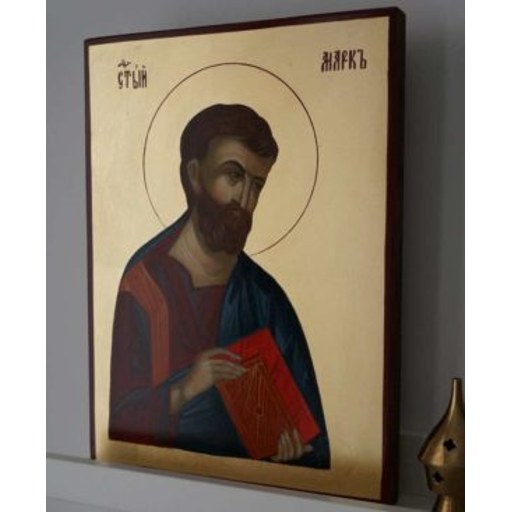
https://www.blessedmart.com/shop/hand-painted-icons/male-saints-icons/st-mark-apostle-and-evangelist/
License: unknown
Evangelist Mark
Saint- Feast Day
- 25 April
- Gender
- male
- Church
- Catholic
Places
Roles & Family
Patronage
Venice;Egypt;Alexandria;lawyers;notaries;barristers;attorneys;captives;prisoners;glaziers;stained glass workers;secretaries;interpreters;lions;against impenitence
Biography
Mark the Evangelist is the figure traditionally credited with composing the Gospel that bears his name, generally regarded as the earliest of the four canonical Gospels and a major narrative source used by the authors of Matthew and Luke. He is commonly identified with John Mark of the Acts of the Apostles, whose mother Mary kept a house in Jerusalem that served as a meeting place for the earliest Christian community. New Testament letters further present him as a cousin of Barnabas. The earliest extra-biblical testimony to his literary work comes from Papias of Hierapolis in the early second century, as reported by Eusebius of Caesarea: Papias described Mark as the interpreter of the apostle Peter who wrote down, though not in chronological order, what he had heard Peter preach concerning the words and deeds of Jesus. That Petrine connection is echoed in the First Letter of Peter, which greets the churches from “Babylon” (commonly understood as Rome) together with “my son Mark.” A precise year and place of birth are not recorded in any early reliable source; later Coptic tradition places his origin in Cyrene in the Libyan Pentapolis and a subsequent family move to Jerusalem, but these details cannot be independently verified.
According to Acts, John Mark accompanied Barnabas and Saul (Paul) from Jerusalem to Antioch and then on the first missionary journey through Cyprus and into Asia Minor, but he left the mission at Perga in Pamphylia and returned to Jerusalem. That withdrawal later produced a sharp disagreement: when Barnabas wished to take Mark on a further journey, Paul refused, and the two apostles separated, Barnabas sailing to Cyprus with Mark. Later Pauline correspondence, however, attests a reconciliation. Mark is named among Paul’s fellow workers in letters associated with captivity, and the Second Letter to Timothy asks that Mark be brought because he is useful for ministry. Taken together, the New Testament therefore portrays him as a Jerusalem Christian of the first generation who worked, at different times, with Barnabas, Paul, and Peter, and who was present in Rome in the orbit of the Petrine and Pauline missions. Ancient tradition, following Papias, holds that the Gospel was composed in that Roman setting for a largely Gentile audience, though the exact decade remains a matter of scholarly discussion rather than documented fact.
Church historians from the fourth century onward, above all Eusebius, relate that Mark subsequently evangelized Egypt and founded the Christian community of Alexandria, becoming its first bishop. The Coptic Orthodox Church regards him as the first Pope and Patriarch of Alexandria and traces its apostolic succession to his ministry; the Greek Orthodox Patriarchate of Alexandria likewise counts him as its founder. Precise dates for his arrival and episcopate are not securely known. Eusebius places Mark’s activity in Alexandria in the reign of Claudius and records that Annianus succeeded him in the eighth year of Nero, while Jerome states that Mark died in that same year of Nero and was buried in Alexandria. Later hagiographical narratives, including the Acts of Mark, describe a martyrdom in the city: he is said to have been seized by opponents during a pagan festival, dragged through the streets with a rope about his neck, and to have died of his injuries, after which Christians buried his body. These martyrdom details belong to later tradition rather than to contemporary documentation, but the association of his death and burial with Alexandria is consistent in ecclesiastical memory from late antiquity.
Veneration of Mark spread throughout East and West. His principal feast is kept on 25 April in the Roman and Byzantine calendars; the Coptic Church commemorates his martyrdom on 30 Parmouti. In Christian art he is symbolized by a winged lion, one of the four living creatures of Ezekiel and Revelation assigned to the Evangelists, an image often linked to the opening of his Gospel with a voice crying in the wilderness. In 828 Venetian merchants translated what they believed to be his relics from Alexandria to Venice, where they were enshrined in the Basilica of Saint Mark; the lion of Saint Mark became the emblem of the Venetian Republic. A portion of the relics, including the head according to some accounts, remained associated with Alexandria. He is invoked as patron of Venice and of Egypt, of lawyers, notaries, and related professions, and of several other causes, and he remains the central apostolic founder for the churches of Alexandria as well as the traditional author of the second Gospel.