Evaristus is a saint of the Catholic Church (d. 107). Evaristus's feast day is celebrated on 26 October.
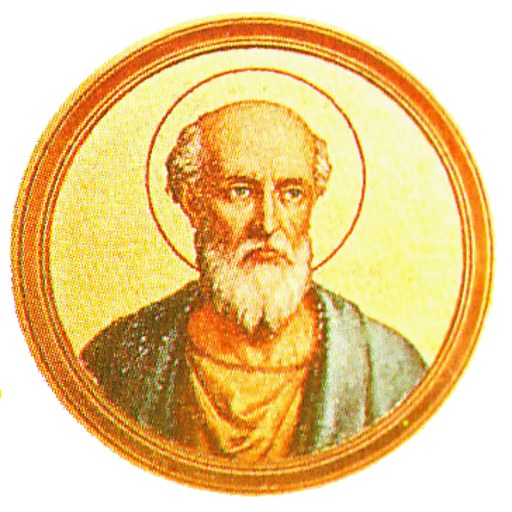
Unknown authorUnknown author
License: Public domain
Evaristus
Saint- Life Span
- d. 107
- Feast Day
- 26 October
- Gender
- male
- Church
- Catholic
Places
Relics & Where to Venerate
Location unknown
The bodily remains of Evaristus are a first-class relic. Venerated at Vatican Necropolis.
Roles & Family
Biography
Pope Evaristus, whose name appears in Greek as Euaristos and who is sometimes called Aristus in later lists, was Bishop of Rome at the turn of the first and second centuries. In the traditional reckoning of the popes he is the fifth successor of Saint Peter, following Linus, Anacletus (also called Cletus), and Clement I. The most important early witness to this succession is Saint Irenaeus of Lyons, who in the late second century, in the third book of Against Heresies, enumerated the bishops of Rome in order to demonstrate the public and continuous transmission of apostolic teaching in that church; Evaristus stands in that list between Clement and Alexander. Eusebius of Caesarea, writing in the early fourth century, likewise placed Evaristus in the Roman succession and associated his episcopate with the reign of the emperor Trajan, assigning him a tenure of roughly eight years.
Virtually nothing can be known with historical certainty about Evaristus’s birth, family, or early life. No second-century source records a year or place of birth. The Liber Pontificalis, a Roman compilation whose earliest papal notices were shaped in late antiquity, asserts that he was a Greek by origin and the son of a Jew named Judah from Bethlehem. These particulars have been repeated in many later martyrologies and popular accounts, but they rest on a source that is not contemporary and that frequently supplies legendary or anachronistic detail for the first-century and early second-century popes. Modern historians therefore treat the Bethlehem and Jewish-Greek origin story as unverified tradition rather than established fact. The chronology of his pontificate is likewise approximate: conventional modern lists often date it from about 99 to about 107, while Eusebius’s synchronism with the twelfth year of Trajan would place the end of his life a little later. No imperial document or contemporary Roman inscription confirms the exact years.
Later Roman tradition, again chiefly the Liber Pontificalis, attributed to Evaristus certain organizational acts: the division of the city of Rome among the priests by titular churches (tituli) and the appointment of seven deacons to assist the bishop. Such measures correspond to the later structure of the Roman church and are widely regarded as projections of fourth- or fifth-century practice onto the early second century; they cannot be corroborated from sources of Evaristus’s own time. He is said to have been buried on the Vatican Hill near the resting place of Saint Peter, a claim consistent with the burial of several early bishops of Rome in that area, though the precise location of his grave is unknown. From an early period he was commemorated as a martyr. The Roman Martyrology records him on 26 October and still styles him a martyr; yet no contemporary narrative of a trial or execution under Trajan or any other emperor survives, and some scholars consider the martyr title conventional for early popes rather than a documented historical event.
Evaristus was succeeded by Alexander I. His name continued to appear in the Roman episcopal lists used by later writers such as Epiphanius and in the early medieval papal catalogues. In the Latin Church he was honoured as a saint, and his feast on 26 October stood in the General Roman Calendar until the liturgical reform of 1969, after which the celebration was reduced to a commemoration in the Martyrology. He is recognized as a saint in the Catholic Church; Eastern Christian calendars have also preserved his memory in some traditions. Because the surviving evidence is so limited, a careful historical portrait of Evaristus must remain modest: he was a Bishop of Rome whose place in the succession is securely attested by Irenaeus within a few generations of his death, who governed the Roman church in the age of Trajan, and around whom later centuries gathered administrative legends, a martyr’s crown, and a traditional origin in Bethlehem. Distinguishing those later elaborations from the slender second-century record is essential to any responsible account of his life.