Evergistus is a saint of the Catholic Church. Evergistus's feast day is celebrated on 24 October. Evergistus is the patron saint of those suffering from headaches.
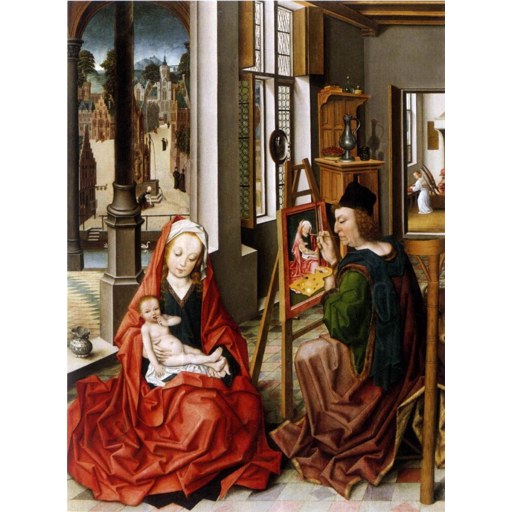
https://dailyartmagazine.com/saint-luke-the-ultimate-holy-painter
License: unknown
Evergistus
Saint- Feast Day
- 24 October
- Gender
- male
- Church
- Catholic
Places
Roles & Family
Patronage
those suffering from headaches
Biography
Evergistus, more commonly known in historical and liturgical sources as Evergislus, Eberigisil, Eberigisilus, or Evergisilus, was a bishop of Cologne in the late sixth century. He is among the relatively few Merovingian bishops of that see whose existence is confirmed by a contemporary writer. Gregory of Tours, in both his Histories and his Glory of the Martyrs, refers to Eberigisilus as bishop of Cologne (Colonia Agrippina). Those notices place him in the episcopal succession of the Rhineland during the Austrasian Frankish period, when the cult of the so-called Theban Legion martyrs was being organized in and around Cologne. No contemporary source records his parentage, place of birth, or year of birth. Later medieval lives that give him a senatorial origin at Tongeren (Tongres) cannot be verified from sixth-century evidence and should be treated as legend.
Gregory of Tours relates that Bishop Eberigisil took an active interest in the relics of early Christian martyrs associated with the Rhine. In the Glory of the Martyrs, Gregory describes how the bishop, after receiving indications concerning the burial place of the martyr Mallosus, recovered that saint’s body at Birten near Xanten and provided for its veneration. The same circle of traditions links Evergistus with the church of Saint Gereon in Cologne, a principal center of the Theban Legion cult. These notices show a bishop engaged in typical pastoral and cultic work of a sixth-century Gallo-Frankish prelate: the discovery, authentication, and housing of martyr relics, and the construction or embellishment of churches. Gregory does not narrate Evergistus’s death, and the bishop was still living when Gregory wrote some of the relevant passages in the 580s and early 590s.
A much later hagiographical tradition, preserved in medieval Cologne and in subsequent martyrologies, recast Evergistus as a martyr. According to this legend he was born of a noble family at Tongeren in the old civitas Tungrorum, was formed in the clerical life at Cologne—sometimes anachronistically under Saint Severinus of Cologne, whose traditional dates do not fit a late-sixth-century pupil—and was raised to the episcopal see. While on a visitation, either at Tongeren or in the region of Brohl in the Eifel, he was attacked by robbers or pagan raiders and killed, traditionally by a blow to the head. His body was said to have been brought back to Cologne and buried in the cathedral church of Saint Peter. The story of a violent death, which is not supported by Gregory of Tours, accounts for his later liturgical title of bishop and martyr and for the folk patronage against headaches. The year of death commonly printed in older directories, around 593, is conventional rather than documented.
The cult of Evergistus remained essentially local to Cologne. His feast was assigned to 24 October in the Roman Martyrology and in the calendars of the archdiocese. Relics associated with him were kept in Cologne; in the later Middle Ages they were connected with the church of Saint Kunibert as well as with the cathedral. He was never the object of a formal papal canonization of the later medieval type; his name entered the martyrology through episcopal and local recognition, as was customary for early bishops. Modern historical scholarship accepts him as a genuine sixth-century bishop of Cologne attested by Gregory of Tours, while treating the Tongeren birth, the discipleship of Severinus, the precise circumstances of a martyrdom, and any exact year of death as products of later legend rather than as recoverable biographical fact.