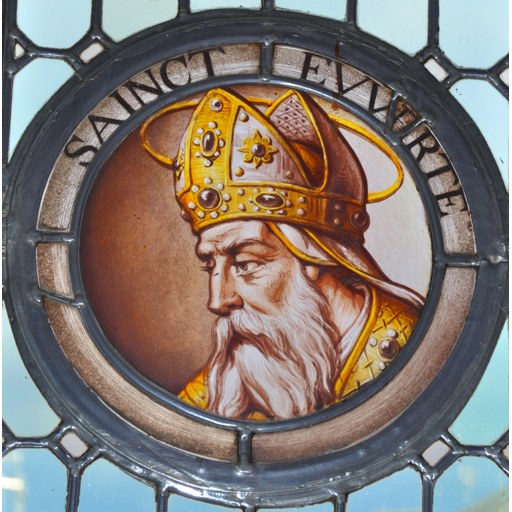
Evurtius of Orléans is a saint of the Catholic Church (d. 340). Evurtius of Orléans's feast day is celebrated on 7 September.
Gentil Hibou
License: CC BY-SA 3.0
Evurtius of Orléans
Saint- Life Span
- d. 340
- Feast Day
- 7 September
- Gender
- male
- Church
- Catholic
Places
Roles & Family
Biography
Saint Evurtius, known in French as Saint Euverte or Euvert and in Latin as Evurtius or Evortius, was a bishop of Orléans in Roman Gaul during the fourth century. Almost nothing about his birth, family, or early career can be established from contemporary evidence. Later medieval hagiography portrays him as a Roman cleric who came to Orléans and was chosen bishop after a miraculous sign: when the see fell vacant, a dove is said to have descended and settled upon him during the electoral assembly, which those present took as a mark of divine choice. That episode belongs to a widespread type of episcopal-election legend and is not corroborated by fourth-century documents; it should be read as pious tradition rather than as verified biography.
Traditional catalogues of the bishops of Orléans place him in the reign of Constantine the Great, in the first half of the fourth century. Local tradition credits him with building or restoring a church dedicated to the Holy Cross, regarded as a predecessor of the later Cathedral of Sainte-Croix at Orléans. No contemporary inscription or chronicle confirms that attribution, though the Holy Cross dedication of the Orléans cathedral is ancient. Evurtius appears in early medieval episcopal lists of the see, but the sequence and chronology of its first occupants remain uncertain to modern historians. He is not to be confused with Saint Anianus (Aignan) of Orléans, a fifth-century bishop remembered for his role when Attila threatened the city.
According to the received tradition he died at Orléans around the year 340 and was buried there. In the seventh century a Benedictine monastery, the Abbey of Saint-Euverte, was founded at the site of his tomb, and his relics were venerated in that church. His feast is kept on 7 September, the date under which the Roman Martyrology commemorates him as a bishop and confessor. His cult is liturgical and ancient rather than the result of a formal papal canonization of the later medieval type.
The surviving historical dossier is thin. No writings by Evurtius are known, and the principal witnesses are martyrologies, episcopal catalogues, and later vitae. He remains an important figure in the religious memory of Orléans, where the former abbey church of Saint-Euverte and the local calendar preserve his name. Historians treat the Constantinian setting and the approximate death date as traditional rather than as strictly documented fact, while accepting that a bishop of this name was commemorated at Orléans from an early period.