Exupère, Félicien et Séverin is a saint of the Catholic Church.
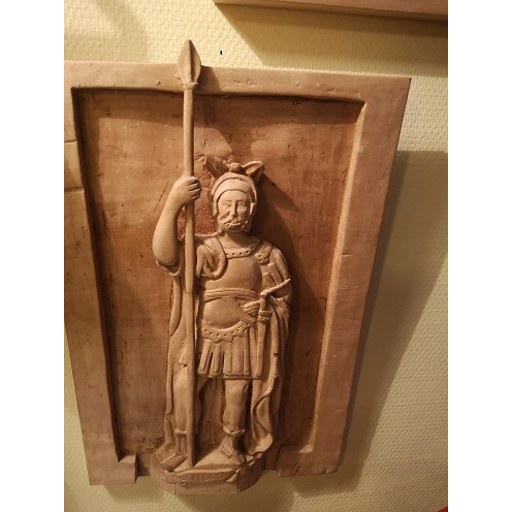
https://saint-felicien.fr/decouvrir-saint-felicien/qui-etait-st-felicien
License: unknown
Exupère, Félicien et Séverin
Saint- Gender
- male
- Church
- Catholic
Roles & Family
Biography
Exupère, Félicien and Séverin are the French forms of the Latin names Exuperius, Felicianus and Severinus, three masculine Christian names that occur separately across the sanctoral of late antiquity and the early Middle Ages. As a single grouped subject they appear in French-language Catholic usage, which points to a local or regional cult, a shared titular dedication, or a joint liturgical memory rather than to three figures whose lives are narrated together in the principal universal sources. The Roman Martyrology, the Martyrologium Hieronymianum, and the widely circulated medieval legendaries do not present these three names as one documented company of martyrs or confessors with a shared passio. No contemporary or near-contemporary acta, episcopal list, or reliable translation notice has been identified that would allow their births, deaths, or places of origin to be fixed.
Saints bearing each name individually are well attested, but they are not customarily joined to one another. Exuperius is known as a bishop of Toulouse in the early fifth century and, in another cult, as a standard-bearer associated with the Theban Legion at Agaunum. Felicianus is the name of an early bishop of Foligno and of several martyrs commemorated on different days. Severinus is borne by the apostle of Noricum, by bishops in Gaul and Italy, and by various confessors. None of these better-documented individuals is grouped with the other two under a single feast, a single set of relics, or a single legendary cycle in the standard reference works of hagiography. The present trio is therefore best understood as a local devotion, possibly arising from the translation of relics or from the patronage of a particular church in the French-speaking world, rather than as a historically reconstructable episode of persecution or missionary work.
Because no reliable vita survives for Exupère, Félicien and Séverin as a group, their century, Roman province or civitas, state of life, and manner of death cannot be stated with confidence. The Latin forms of the names are consistent with Christian onomastics from roughly the third to the sixth century in Gaul and Italy, but that observation is only a linguistic inference, not a documented chronology. Nothing certain can be said about whether they were bishops, monks, clerics, or laymen, nor whether they died as martyrs or as confessors. Early papal and patriarchal lists contain no Bishop of Rome or patriarch of an Orthodox, Oriental Orthodox, Coptic, or Church of the East see corresponding to this trio, and there is no evidence that any of them occupied those offices.
Local Catholic calendars in France frequently preserve the names of early holy persons whose individual biographies were never written down or have been lost. In such cases the Church has traditionally permitted veneration on the basis of immemorial cult rather than on a critically established life. If this group belongs to that category, their feast day, patronage, and burial place would be matters of diocesan or parish tradition rather than of universally published documentation. Until a verifiable local martyrology, a diocesan proper, an archival notice, or an archaeological report can be cited, those particulars, together with any claim of religious profession, marriage, or children, must remain unspecified. The grouping itself, however, indicates that some community has kept their memory, even if the content of that memory has not entered the mainstream historical literature in a form that can be checked.