Exuperius is a saint of the Catholic Church (d. 286). Exuperius's feast day is celebrated on 22 September.
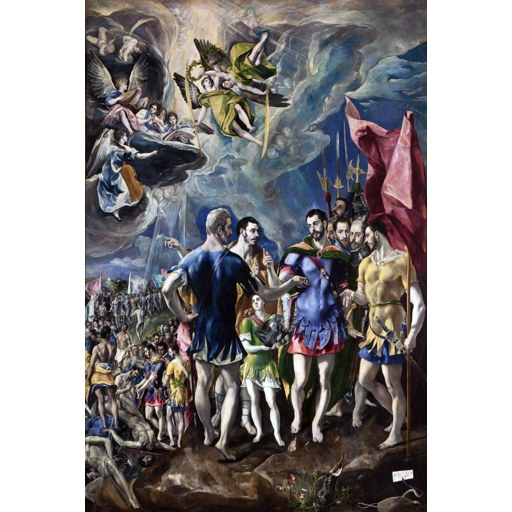
El Greco
License: Public domain
Exuperius
Saint- Life Span
- d. 286
- Feast Day
- 22 September
- Gender
- male
- Church
- Catholic
Places
Roles & Family
Canonization
Biography
Saint Exuperius, also known as Exupernis or by the French form Exupère, is venerated as a Christian martyr of the later third century. In the hagiographical tradition he is the standard-bearer (signifer) of the Theban Legion, a Roman military unit said to have been recruited from Thebes in Egypt and to have consisted entirely of Christians. The principal early narrative is a letter composed in the fifth century by Eucherius, bishop of Lyon, addressed to Bishop Salvius. Eucherius names Exuperius among the legion’s chief figures, together with Maurice, described as commander (primicerius), and Candidus, an officer (senator). The legion is given the symbolic strength of 6,666 men. No contemporary document records Exuperius’s parentage, date of birth, or career before the events at Agaunum; his Egyptian origin is inferred from the identity of the legion itself.
According to that tradition, during the reign of the emperor Maximian the Theban Legion was ordered into Gaul, in a campaign customarily placed around the mid-280s. After crossing the Alps the troops encamped in the valley of the Rhône near Octodurum, the modern Martigny. Maximian is said to have commanded the army to offer sacrifice to the gods and to join in measures against local Christians. The Theban soldiers refused. The emperor then ordered a decimation, the execution of every tenth man. Exuperius, Maurice, and Candidus are depicted as exhorting their comrades to persevere. A further decimation followed, and at last the remainder of the legion was put to death at Agaunum, the place later called Saint-Maurice in the present Swiss canton of Valais. The massacre is traditionally assigned to the year 286, though the fifth-century source does not itself supply a precise date.
Exuperius is therefore numbered among the martyrs of Agaunum. The cult of the Theban martyrs is attested by the later fourth or early fifth century. A local bishop, Theodore of Octodurum, is credited with finding remains and building a basilica over the burial site. In 515 the Burgundian king Sigismund founded the Abbey of Saint-Maurice d’Agaune on that spot; the monastery became a major shrine and the centre from which relics attributed to the legionaries, including Exuperius, were distributed across Gaul and neighbouring regions. Medieval martyrologies and litanies include Exuperius among Maurice’s companions. His feast is observed with that of the Theban Legion on 22 September. He was never the subject of a formal papal canonization; like other ancient martyrs he belongs to the pre-congregational cultus recognized by the Church.
Critical historians have long treated the episode with reserve. No third-century inscription or military roll confirms an all-Christian Egyptian legion in the Alps, and Eucherius wrote some century and a half after the supposed events. Some scholars interpret the passion as a legend that grew around a smaller group of genuine martyrs or around an existing Alpine shrine; others allow that Eastern troops may have been executed for insubordination and that the story was later given a fully Christian shape. In either reading, the individual biography of Exuperius as standard-bearer remains a feature of hagiography rather than of independently documented history. He continues to be honoured in the Catholic Church among the martyrs of the Theban Legion, without a distinct, well-documented personal patronage.