Eysteinn Erlendsson is a saint of the Catholic Church (d. 1188). Eysteinn Erlendsson's feast day is celebrated on 26 January.
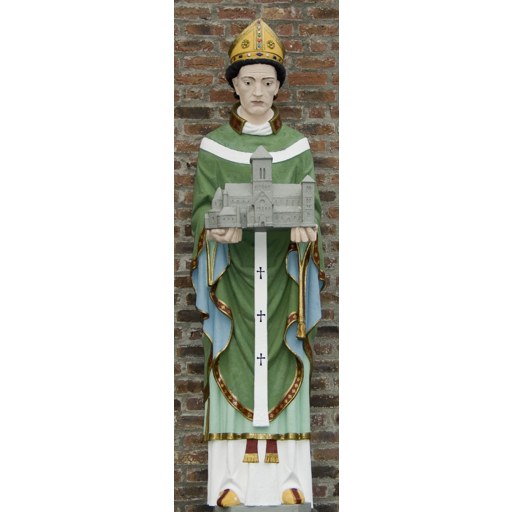
Morten Dreier
License: CC BY-SA 2.5
Eysteinn Erlendsson
Saint- Life Span
- d. 1188
- Feast Day
- 26 January
- Gender
- male
- Church
- Catholic
Places
Roles & Family
Biography
Eysteinn Erlendsson (Norwegian Øystein Erlendsson; Latin Augustinus Nidrosiensis) was a twelfth-century Norwegian prelate who served as Archbishop of Nidaros from about 1161 until his death in 1188. He came of a prominent family in Trøndelag; his father, Erlend Himalde, was a lendmann. No contemporary source records an exact year or place of birth. He received an unusually advanced education for a Norwegian of his generation, studying in France and being associated with the schools of Paris and, in some accounts, with the Abbey of Saint-Victor. After returning home he served as chaplain to King Inge I Haraldsson and held administrative office in the royal household, which placed him at the centre of both church and court before his elevation to the metropolitan see.
After the death of Archbishop Jon Birgersson in 1157, Eysteinn was chosen as successor. He obtained confirmation and the pallium from Pope Alexander III, whose cause he supported during the Alexandrine schism, and was consecrated around 1161. As metropolitan of a province that included the Norwegian dioceses and the Norse churches of the North Atlantic, he worked to tighten ecclesiastical organisation, to secure tithes and church property, and to introduce Gregorian standards of clerical discipline. He was a principal architect of the alliance between the Church and the faction of Erling Skakke and Erling’s son Magnus Erlingsson. In 1163 or 1164 he crowned Magnus at Bergen—the first coronation of a Norwegian king—and helped frame a succession law that privileged legitimate royal birth and bound the monarch to protect the Church.
Eysteinn was a major patron of the cult of Saint Olaf and of Nidaros Cathedral. He is credited with composing or commissioning the Latin Passio et miracula beati Olavi, which carried the martyr-king’s legend into an international clerical milieu. Under his direction the cathedral was substantially rebuilt and enlarged; the octagon over Saint Olaf’s shrine and other features show French and English architectural influence. He also developed the archiepiscopal residence at Nidaros. His political position collapsed as Sverre Sigurdsson and the Birkebeiner gained the upper hand against Magnus. In 1180 Eysteinn went into exile in England, spending about three years there, notably at Bury St Edmunds Abbey. He returned in 1183 and reached a limited accommodation with King Sverre, but relations remained strained. He died at Nidaros on 26 January 1188 and was buried in his cathedral.
After his death Eysteinn was venerated locally as a saint; miracles were reported at his tomb and his feast was kept on 26 January. He was never formally canonised by the papacy, and the cult was suppressed in Norway at the Reformation. Evidence for his life includes papal correspondence, English monastic notices of his exile, the fabric of Nidaros Cathedral, the Passio Olavi, and narrative passages in Sverris saga and other kings’ sagas, which must be read with caution because they reflect the partisan conflicts of the Norwegian civil wars.