Fabian is a saint of the Pre-Schism (Universal) Church (d. 250). Fabian's feast day is celebrated on 20 January.
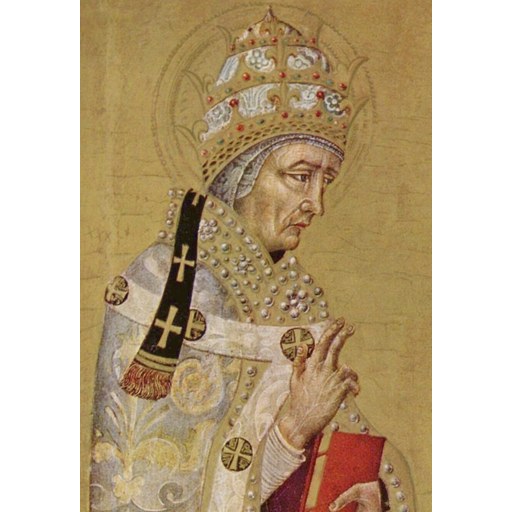
Giovanni di Paolo
License: Public domain
Fabian
Saint- Life Span
- d. 250
- Feast Day
- 20 January
- Gender
- male
- Church
- Pre-Schism (Universal)
Places
Relics & Where to Venerate
Location unknown
The bodily remains of Fabian are a first-class relic. Venerated at Crypt of the Popes.
Roles & Family
Biography
Pope Fabian was Bishop of Rome from 236 until his death in 250. Almost nothing can be established about his family or early years. The Liber Pontificalis, a later Roman compilation, describes him as a Roman by birth and names his father Fabius. He was still a layman, not a member of the Roman clergy, when the church in the city assembled after the death of Pope Anterus to choose a successor.
The fourth-century historian Eusebius of Caesarea records the episode that became the most famous of Fabian's life. While the community considered several well-known clergy as possible bishops, a dove flew in and settled on the head of Fabian, who was present but not a candidate. Those assembled interpreted the sign in light of the Gospel account of the Spirit descending at the baptism of Jesus and elected him by acclamation. He was then ordained and governed the Roman church for about fourteen years, a comparatively long and peaceful pontificate spanning the reigns of Maximinus Thrax, Gordian III, Philip the Arab, and finally Decius.
Administrative work associated with his name includes the division of Rome into seven ecclesiastical districts under deacons and the appointment of subdeacons to collect the acts of the martyrs. He is also credited with recovering from Sardinia the bodies of his predecessor Pontian and of Hippolytus, both of whom had died in exile under Maximinus Thrax, and with giving them burial in Rome. A sixth-century tradition preserved by Gregory of Tours linked Fabian with the sending of seven missionary bishops to cities in Gaul, including Dionysius of Paris and Martial of Limoges; modern historians generally treat that mission as a later legendary construction rather than a securely documented act of the mid-third century. During these years the Roman church remained in contact with other major sees, and Origen of Alexandria wrote to Fabian on doctrinal questions.
The relative calm ended when the emperor Decius, early in 250, required inhabitants of the empire to sacrifice to the traditional gods and obtain a certificate of compliance. Fabian was arrested and died in Rome on 20 January 250, one of the first and most conspicuous victims of the edict. He was buried in the papal crypt of the Catacomb of Callixtus on the Via Appia, where a brief Greek epitaph later identified him as bishop and martyr. Cyprian of Carthage, writing in the months that followed, spoke of him with high praise. The Roman see then remained vacant for more than a year, until the election of Cornelius, because of the intensity of the persecution. Fabian's feast is kept on 20 January in the Latin calendar.