Famianus of Compostela is a saint of the Catholic Church (d. 1150). Famianus of Compostela's feast day is celebrated on 8 August. Famianus of Compostela is the patron saint of Gallese.
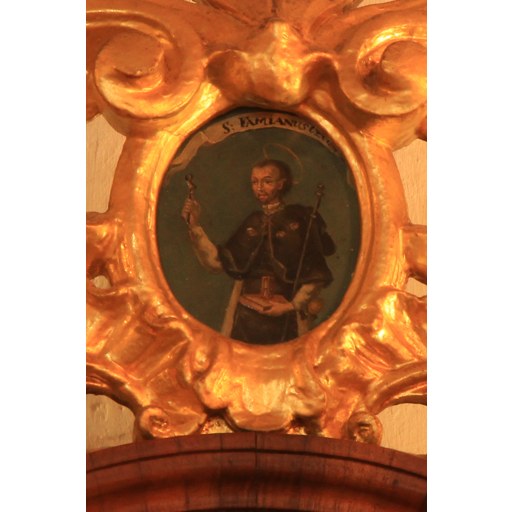
Karl Gruber
License: CC BY-SA 4.0
Famianus of Compostela
Saint- Life Span
- d. 1150
- Feast Day
- 8 August
- Gender
- male
- Church
- Catholic
Places
Roles & Family
Religious Information
Patronage
Gallese
Biography
Famianus of Compostela, known in Italian as San Famiano, was a twelfth-century German pilgrim, Cistercian monk, and hermit venerated as a saint in the Catholic Church, above all in the town of Gallese in the province of Viterbo in Lazio. Later hagiographical tradition states that he was born in Cologne into a family of comfortable means. After distributing his goods to the poor he set out as a pilgrim, first to the shrine of Saint James at Santiago de Compostela in Spain, the journey that gave him the designation of Compostela, and afterwards to Rome and to the holy places of Palestine. Such extended penitential travel was a recognized form of lay devotion in the decades around 1100.
Returning to Italy, he entered the Cistercian Order at the abbey of Santa Maria di Palazzolo in the Alban Hills, a monastery recently brought into the Cistercian observance. Seeking a stricter solitude than community life afforded, he withdrew to live as a hermit in the district of Gallese, in the Tiber valley north of Rome. Tradition portrays him as an ascetic and a worker of miracles who drew the veneration of the local people during his lifetime.
He died at Gallese on 8 August 1150 and was buried there. His tomb in the church later dedicated to him, the Chiesa di San Famiano, became the centre of a durable local cult. His feast is kept on 8 August, and he is regarded as the patron saint of Gallese. The historical record of his life is thin and almost entirely dependent on later medieval and early modern hagiography; no contemporary narrative or archival dossier survives. The essential outline—a German pilgrim who became a Cistercian and then a hermit near Gallese—is nevertheless stable in the sources that preserve his memory.
Veneration of Famianus has remained chiefly regional. He is remembered in Cistercian calendars and in the liturgical life of Gallese, where his relics continue to be honoured. Claims of a formal papal canonization shortly after his death circulate in some modern notices but are not securely documented in the surviving papal registers. For the historian, therefore, Famianus stands as an example of the many twelfth-century penitents whose sanctity was recognized first by a local community and only afterwards, if at all, by wider ecclesiastical authority.